
It’s been a long journey in this 40th anniversary celebration of A Nightmare on Elm Street – all of the films covered, several ANOES knockoffs explored, every episode of the TV show looked at – seasons one and two. And now, for this fifth and final part of my retrospective, I want to take a look at something that I have already mentioned in some of the other parts of this retrospective, Freddy Mania. This was a genuine thing where the Freddy Krueger character became such a massive pop culture icon that he had his very own Beatlemania-like following. Film merchandise was not new. Jaws was the first-ever summer blockbuster back in 1975 and the success of that film was pretty much the birth of film merchandise, then Star Wars was released in 1977 and the idea of film merchandising exploded. However, to have something like that connected to a horror flick was unheard of.
Nowadays, you can get pretty much any kind of merchandise that you can think of in relation to any horror film, but not in the ’80s. Horror merchandising was rarer and harder to find than a good A Nightmare on Elm Street sequel. Not only that, the merchandise surrounding the Nightmare franchise was not strictly positive-focused. You couldn’t get a Nancy Thompson t-shirt, you know, the heroine of the first film – but you could get a Freddy Krueger one. It was weird, we were celebrating a (fictional) child molester and killer and not the heroes of the films. Even I had a Freddy poster on my wall as a teenager… and I couldn’t tell you why. I can remember what it looked like too. It had Freddy standing there with his gloved hand out as if he was about to swipe at you, with Freddy standing against a plain grey backdrop and the A Nightmare on Elm Street title in red and that recognisable font along the bottom.
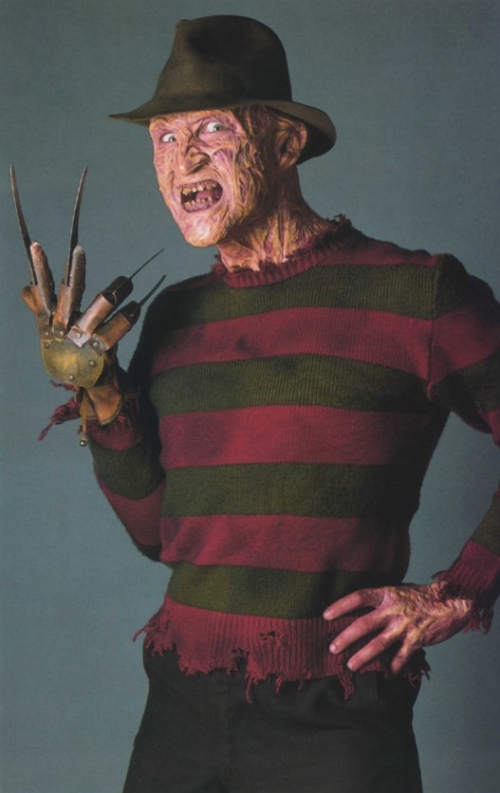
It wasn’t that exact picture, but I’m willing to bet that it was from the same photoshoot judging by the same grey backdrop. There’s nothing wrong with liking a bad guy from a film. I adore Hans Gruber from Die Hard, he’s one of my all-time favourite villains… never had a poster of him on my wall though. Freddy Mania was quite bizarre, to say the least, and it wasn’t focused on just merchandise either, the Freddy Krueger character made several appearances in some unusual places. Freddy Mania probably reached its peak in 1988 with the release of A Nightmare on Elm Street 4: The Dream Master, which held the record for the highest-grossing film in the franchise until Freddy vs. Jason in 2003. While ’88 was the peak of Freddy Mania, it began before then and lasted for a few years afterwards too. That is what this final part of my retrospective is going to explore, Freddy Mania, some of the Nightmare/Freddy merchandising, and the very weird impact that it had. There’s a line that Heather had in Wes Craven’s New Nightmare that, I think, perfectly sums up the impact that Freddy had back then.
Heather Langenkamp: “Every kid knows who Freddy is. He’s like Santa Claus.”
Yeah, pretty much. I was a kid when I first heard of Freddy. I hadn’t seen any of the films then, but I’d heard about him in the school playground as kids shared their stories of the VHS films they rented out over the weekend. Being a father myself now, I try to keep my children away from child killers like Freddy. I’m not going to explore Freddy Mania in any kind of chronological order, I’ll just post some of the more interesting titbits of the Freddy Mania phenomenon. However, one of the first ever known instances of Freddy existing outside of the movies was for a Halloween celebration held at Six Flags St. Louis called Fright Nights in 1988. Freddy was the main star of the event, he was given the title of “entertainment chairman”, and he even had his own haunted house attraction, Freddy’s Nightmare: The Haunted House on Elm Street. Alas, there don’t seem to be any photos or recordings of this event, or the haunted house – which lasted until 1990 with Freddy returning. All I could find was these two ads that featured in the Fort Worth Star-Telegram newspaper.

The idea of a Freddy-focused Halloween theme park attraction started here – but Universal Studios has featured Freddy and the Nightmare films in their Halloween Horror Nights celebrations a few times, with their interactive walk-through attractions.
Freddy has appeared in video games. Most gamers will know of the infamous LJN game on the NES, which I will take a look at very soon. However, that was not the first, the NES game was beaten to the market by a couple of months by the Commodore 64 A Nightmare on Elm Street game in 1989. This was a pretty good game too, an action-adventure that involved a lot of exploration and item management (playthrough here) and an early example of a survival horror title. There was a PC version that had better graphics, but worse sound (playthrough here). Very much ahead of its time when most movie-based games were lazy platformers with little imagination put into them… which brings me to the NES game. This is the one that most gamers are aware of (playthrough here) and yes, it’s a lazy platformer with little imagination put into it. I may as well mention this bit of info, while LJN published the game, Rare developed it. Yes, that Rare of GoldenEye 007 fame. Freddy was also in Mortal Kombat (2011) in a rather mixed-up appearance as the look was based on the remake, but the voice was provided by Robert Englund.
There are a couple of other modern games where Freddy made an appearance too, but Freddy being in Mortal Kombat and others post-2011 is way after the whole Freddy Mania phenomenon, so let me get back to the ’80s and ’90s. There were several Freddy/Nightmare books. There were book adaptions of all of the films from the original to Freddy’s Dead. Some of the adaptions even drastically change from the film to create their own stories. For instance, there’s The Nightmares on Elm Street Parts 1, 2, & 3 adaptions, written by Jeffrey Cooper where the first two follow the films closely, and even add new scenes – but the third one is a totally new story that only uses the film as a basic blueprint. There was a series of books called Freddy Krueger’s Tales of Terror, which were basically a book version of the Freddy’s Nightmares TV show. They were stories that were set in and around Springwood, but Freddy just introduced them. There were several companion books that detailed the making of the films and even an official Freddy Krueger biography. There was a short story collection called Freddy Krueger’s Seven Sweetest Dreams, which is also very similar to Freddy’s Nightmares in book form.

Marvel published two magazine-style comics called Freddy Krueger’s A Nightmare on Elm Street. There were supposed to be more than just the two, but the idea was cancelled. Writer of the comics, Steve Gerber explained the cancellation in 1990.
Steve Gerber: “A note on the why’s and wherefore’s of the magazine’s cancellation (which, incidentally, was a major topic of discussion in the Comics relay a few months back). According to my best information, Marvel cancelled the book in anticipation of pressure from the various anti-violence advocate groups. A few weeks prior to the release of the first NIGHTMARE, there had been an article published in the New York Times decrying the level of violence in comic books. Apparently, that article—along with the picketing that took place outside theatres showing NIGHTMARE 5 in Los Angeles and elsewhere—was enough to make Marvel turn tail and run for cover.
Please note that this is DESPITE the fact that the NIGHTMARE magazine carried a “suggested for mature readers” warning and that NO DIRECT PRESSURE had actually been applied on Marvel.
The cancellation of NIGHTMARE is a textbook example of the “chilling effect” you hear so much about these days in discussions of free speech. The book was killed not because of it WAS criticized, but because the publishers FEARED it would be criticized.
This won’t be the last incident of its type, either. The impulse to censor—led by groups on both the left and the right, and fed by the innate cowardice of American business—is growing in this country. It’s something that anyone who reads for pleasure or edification ought to be aware of, and prepared to combat. In one of the great ironies of history, we have a situation in which the totalitarian nations of the world are on an inexorable march toward freedom, while their very model, the United States, is moving slowly, but dangerously, in the opposite direction.”
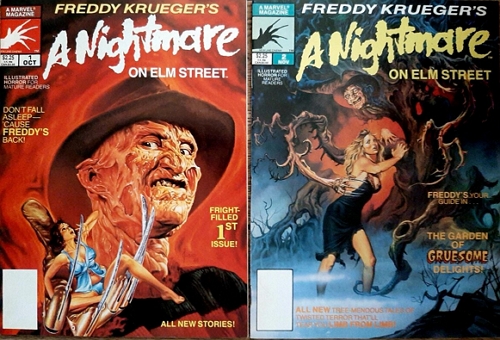
Still, you can’t keep a good dead guy down, and more Freddy comics were released, just not by Marvel. Innovation Publishing put out a multipart comic adaption of Freddy’s Dead: The Final Nightmare in 1991, the last part was even in 3D, like the movie. The whole thing was later released as a graphic novel. There was the multi-issue Nightmares on Elm Street series which included original Freddy stories and even brought back both Nancy and Alice from the films. There was even a comic book sequel to Freddy’s Dead: The Final Nightmare which follows Freddy’s daughter, Maggie and was called A Nightmare on Elm Street: The Beginning. Planned as a four-part series, only the first two were released because Innovation Publishing went bust before the last two could be published. The very famous horror magazine, Fangoria put out special editions of their publication that were dedicated to the films A Nightmare on Elm Street 5: The Dream Child, Freddy’s Dead: The Final Nightmare, Wes Craven’s New Nightmare, and even Freddy vs. Jason. These special editions focused solely on each film and were full of behind-the-scenes info, interviews, pictures and such.

I think that one of the most bizarre Freddy appearances was on MTV in 1988. Freddy was given his own hour where he introduced clips from the films, several music videos and plugged the hell out of A Nightmare on Elm Street 4: The Dream Master – which was due to be released a couple of months after this MTV special. Thanks to issues with the music videos, this special can’t be legally shown anymore, unless somebody wants to pay several music companies a lot of money to clear the music rights. However, there are edited versions on YouTube that include all the Freddy bits, but none of the music videos – like this one right here. MTV was massive back in 1988, so for Freddy to get his own special just showed how much of an impact he had.

And now for some merchandise. Oh man, there was a ton of Freddy merchandise, some of which I covered in a previous article where I looked at kids’ entertainment based on adult-rated films – so I may be in danger of repeating myself a bit here, but there’s still going to be a ton of new stuff. For example, did you know that there was an official Elm Street catalogue in 1989? Now, I do just need to remind you of something I wrote in the intro. Horror merchandise was quite rare, there was some in the ’80s, but it wasn’t as easy to find as something like Star Wars. Even then, what you would find would be lumped under one horror genre. You’d never see dedicated catalogues for one specific horror film, just a general horror genre kind of thing. But this was a dedicated Elm Street catalogue, specifically for Freddy and the Nightmare franchise alone where you could buy posters, VHS tapes, t-shirts, jackets and much more.

Yeah, you could buy Freddy masks, clothing, watches, jewellery (there was official Freddy jewellery?), makeup kits, models, action figures (talking and non-talking), board games…the list goes on and on. There was a shit-load of this stuff. Do you know what else I found in the Elm Street catalogue? Another ad for that Six Flags Halloween event.

But back to all that Freddy merchandise. Did you ever want a cheap-looking, plastic Halloween costume for your kid in 1987? Oh yeah, there was one of those too. This kind of thing made very little sense to me. Freddy was a child killer and in ’87, you could (badly) dress your kid up as a child killer. Is that not just a little bit perverse? I did mention this in my previous article that I linked to before, but you could even get official A Nightmare on Elm Street pyjamas for kids. That’s beyond perverse because not only did Freddy kill kids, he killed them in their sleep – and in the ’80s, you could dress your little ‘un up as Freddy and send him off to bed.

There was Freddy bubble gum, yo-yos and a ton of other kid-aimed goodies. There was a Freddy album. I shit you not, a real music album called Freddy’s Greatest Hits from The Elm Street Group. Now, this was not the first time that Freddy has had a musical connection as there was the unofficial A Nightmare On My Street from DJ Jazzy Jeff & The Fresh Prince, which got them into some legal hot water, to the point where a judge ordered that the music video be destroyed. However, it turns out that not all of the copies were destroyed and the video eventually found its way online in 2018. Freddy appeared and rapped with The Fat Boys for Are You Ready For Freddy? no legal issues as this was official. And, of course, Freddy was in the music video for Dokken’s Dream Warriors which combined footage from Nightmare 3 and new footage shot just for the video. But this Freddy’s Greatest Hits album was something very different and aimed at children. Don’t believe me? Just have a listen to the first first track teaching how to Do The Freddy dance. There’s no way that this album was aimed at adults.

I need to wrap this up, but Freddy Mania was… well, it was manic – and I’ve only touched on some of the Freddy-related guff here. Just to finish, I want to take a quick look at a couple of other bizarre Freddy things. There was an official Freddy Fan Club (as mentioned on that Freddy album above). Again, there was no way that this was for adults. The Freddy Fan Club began in 1988 when Freddy Maina was at its peak and just before the release of Nightmare 4. You’d have to write to a PO box address and you’d be sent your welcome pack. This pack had a welcome letter (see below), ads for the new film and Freddy merch, posters, The Freddy Times – which was a faux newspaper which detailed the making of Nightmare 4 and more. There was a bio/backstory to Freddy about his youth, you can read it right here. You even got a membership card… for what? No adult was going to be walking around with a Freddy Fand Club membership card in their wallet. This was for kids, wasn’t it? Oh yeah, here’s that welcome letter.

The last thing I want to bring up, Freddy had a hotline. Just dial 1-900-860-4FRED and you could take part in a phone trivia game where you could win a chance to be in the next Nightmare film. There was another phone line (1-900-909-FRED) that you could call and listen to scary stories. Here are the ads for those very phone lines. If you are old enough, you may remember these things, they cost a fortune and the recordings would drag on to squeeze as much money from the caller as possible. I found someone who claimed that they called the Freddy story phoneline as a kid and they said at first, you got 2 minutes of the Nightmare theme, with the sound of Freddy’s knives scraping. At $2 for the first minute and 45c for every additional minute, you’ve already spent $2 and have not even heard Freddy talk yet. Then Freddy would introduce a non-specific story (I guess they had Robert Englund record multiple intros that could be put in front of any of the stories), and then another voice (or voices) would tell a short story. Yep, Freddy himself never told the tales, just some random, struggling-to-find-work actors. I don’t know why I explained all of that as somebody recorded several of the stories and uploaded them to YouTube…
At the time, I most probably thought that all of this Freddy Krueger exposure was awesome. Looking back, it really was rather strange. As I said before, we were not idolising the heroes of the films, we were championing the villain. As Nancy’s mom said in the first film, Freddy was: “a filthy child murderer who killed at least 20 kids in the neighbourhood”… and we had him on t-shirts, bubble gum, yo-yos. posters, board and video games, music albums and so much more – all aimed at kids too. The impact of Freddy Krueger and Freddy Mania was insane and no other horror icon has ever had such a massive following before or since. Freddy Krueger was a rock star of the horror world.
 Little Bits of Gaming & Movies
Please leave a reply/comment.