
Have you ever noticed that, when during a chat/argument between an American and a British person, the American will always reel out the tired old – “If it wasn’t for us, you would all be speaking German”, line? You can often replace the “you would all” with “ya’ll” too. It doesn’t matter what the discussion is about, an American will always try to silence a Brit with that declaration. For those not in the know, this in reference to World War II and how America won the war, thus preventing Hitler from taking over the UK… but it’s utter bollocks.

I’m going to ignore the “your welcome” there and not bring up ironic poor grasp of English. Before the Yanks got involved in the scrap, after sitting on the side-lines for so long and hiding away until Pearl Harbor happened at the end of 1941 – The UK had already won the Battle of Britain in 1940. The Nazis tried to invade and take over the UK, but we pulled Gerry’s trousers down and sent them away following a severe spanking, despite being vastly outnumbered. After which, the Germans were on the back foot and losing their grip, which led to the end of the war. It was the Battle of Britain that helped turn the tide of the war in favour of the allies. There was a mix of nationalities fighting in the Battle of Britain, Polish, Belgians, Aussies and even Canadians. Then, of course, Hitler thought it would be a good idea to turn against the Soviet Union… which was another massive nail in the coffin of the Nazis. All before the US decided to get their hands dirty too. Now, I’m not saying that the Yanks didn’t help, they did… eventually. But they didn’t stop the Germans from taking over the UK and thus, prevent us from speaking German. Then, the overall fight was won as a collective. not the US alone.
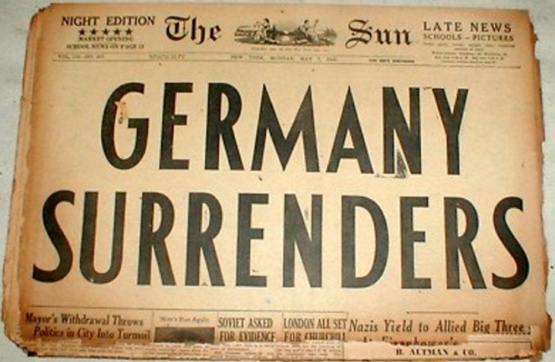
What America did was join a fight that was already being won. It was the equivalent of a team winning a football match 5-1 and the manager bringing on a sub in the last few minutes before the final whistle. The sub (a fresh pair of legs among the rest of the tired team who have done all the hard work from the start) scores a single goal to make it 6-1… but then claims that he should be declared the man of the match.
But what does any of this have to do with the 1983 game crash? Well, it’s all about having a skewed perspective on history and spouting incorrect statements – because America seems to think that the ’83 game crash was a major event and that it was Nintendo using Mario that saved the industry. Much like the “If it wasn’t for us, you would all be speaking German” line, that’s utter bollocks. I’ve personally even had this very discussion recently in a gaming group that I am part of. The subject of the chat got onto important games and some Yank chipped in saying that Super Mario Bros. on the NES was the single most important game ever made – because it saved the entire gaming industry following the infamous 1983 game crash. But it didn’t.

First, a very brief history of the game crash.
To be honest, I’m not 100% sure why it is even called the videogame crash of 1983. Technically, it began in 1982 and carried on until around 1985. Anyway, there were several popular gaming consoles back then, the Intellivision, ColecoVision, Vectrex (that one’s for you Badger) and the mighty Atari 2600 were the main machines, with the 2600 being the big hitter. The end of 1981 and early 1982 saw a serge in the videogame market and the first console war was being fought between Coleco’s ColecoVision and Atari’s wooden beast, the Atari 2600 (previously called the VCS). Coleco even had the brass balls to sell and add-on that allowed you to play 2600 games on the ColecoVision. Yeah, a manufacturer allowing a competitors games to be played on their machine. This was long before copyright infringement became a major thing in the world of gaming.
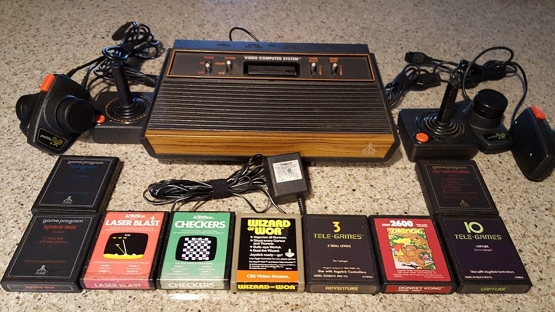
The industry was doing great in early 1982. As a result, the market leaders started to analyse where this trend would head later in the year, and those analytics were huge. So manufactures began to produce a lot more hardware and software to meet their projected demand. Only, that demand was not really there. It was projected… badly. By the end of 1982, there were masses of surplus hardware and software from the big companies. By the time 1983 was coming to an end, a lot of that surplus was still left in the shops. It’s not that people were not buying, it was more a case that the likes of Coleco and Atari overproduced their goods and overestimated how much they would sell. There was also the issue that a lot of the software that was being churned out was of pretty poor. They really went for a quantity over quality approach.

Then there was the fact that home computers were becoming cheaper and they often had more memory and faster processors than the consoles did too. So while the ColecoVisions and Atari 2600s were being piled high in warehouses and on shop floors, people were buying Commodore 64s and VIC-20s instead – because not only could they play better/more complex games, they could be used for business and school work too. The consoles didn’t stand a chance as they were less powerful and less flexible. The console leaders began to lose a lot of money because they had all this (over projected) stock and people were not buying it. Hence, a videogame crash. That’s the basic gist anyway, it is a tad more in-depth. But the basics are that the big companies flooded the market with hardware and software at a time when the market was changing and folks were spending their money elsewhere.

Oh, and while I’m here. Another misguided “fact” about the game crash is that it wasn’t caused by E.T. the Extra-Terrestrial on the Atari 2600. E.T. was released for Christmas 1982 and (as covered) the game crash had already begun by then. In fact, one of the main reasons that Howard Scott Warshaw was (famously) only given a few weeks to design and program the game was to get it on shop shelves for Christmas to try to combat the slump that was ongoing at the time. E.T. the Extra-Terrestrial was just caught up in the maelstrom, it didn’t cause it. Oh, and E.T. is nowhere as bad a game as people tend to over exaggerate it either.
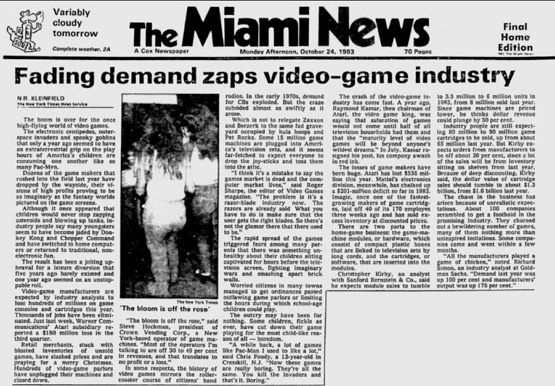
So then, why wasn’t this game crash as big a deal as a great many people think? Because it only really affected North America. You see, while the Yanks had newspapers headlining the “major” story that the games industry was collapsing, the rest of the world really didn’t give a fuck. Here’s the thing about a lot of Americans, they don’t seem to realise that there is an entire planet of other countries and other people outside of the USA. While the videogame crash of 1983 was a massive news story in the US, the rest of the world were too busy playing games to notice.
For instance, here in the UK, we had the bedroom programmer, the genesis of the indie game scene. We had people like Matthew Smith and Jeff Minter pioneering home computer games. The games industry was never in any danger of collapsing because the industry was not only doing fine, it was thriving in other territories like Europe and Japan. While Atari were burying surplus stock in a landfill in New Mexico – I, and many others were too busy playing games on our ZX Spectrums and Commodore 64s to care. We had our heads buried in ground breaking titles like Elite, Skool Daze and Turbo Esprit. Software that was not only made right here in Blighty, but titles that would change the industry moving forward. Yeah, the US may have been having issues as Coleco and Atari were sinking fast, but that was only in North America. I really do think that the videogame crash of 1983 needs to be renamed to: the slight bump in the US that really didn’t make much of an impact anywhere else in the world.

This, dear reader, is why Nintendo and Mario never saved the industry… because it never needed saving to begin with. The games industry was far, far bigger than one country and the issues in the US had no major impact outside of the US. I guess you could claim that Nintendo and Mario helped to make gaming more popular in the US at the time, but not that they saved the industry.
 Little Bits of Gaming & Movies
Please leave a reply/comment.