
Don’t ask me why, but a little over a week ago I had an inexplicable urge to play Godus. This is a game with quite the bitter history, and a history that I will need to delve into. So, here it goes…
Godus was developed by 22 Cans, a small indie studio founded by Peter Molyneux. Peter is one of the greatest, most-loved and respected British videogame designer/programmers… up to a point. He began his career by making a small game called The Entrepreneur in 1984, a business simulation that was released at a time when gamers wanted to play anything but a business sim. Publishing the game himself too, Peter only received two orders for a copy, and one of those was from his own mother. It was a massive flop.

Long story short and Peter Peter Molyneux then founded Taurus Impex Limited, which exported baked beans to the Middle East. About as far away from creating videogames as you can get. Enter Commodore, who mixed up Peter’s Taurus company with Torus, who specialised in making networking software. Commodore asked Peter and Taurus to port his networking software to the Amiga… but he didn’t have any networking software to port to the Amiga, he just had a load of baked beans. Peter, not wanting to loose out on the promise of ten free Amiga computers from Commodore, agreed to the deal and got to work making Acquisition – The Ultimate Database for The Amiga. This led to the whole exporting baked beans thing being dropped as Peter and his business partner, Les Edgar co-founded Bullfrog Productions in 1987.
Thus began one of the greatest software studios, ever. Starting our by porting Druid II: Enlightenment to the Amiga, Bullfrog really came into its own when Peter came up with Populous, the very first God game and released in 1989 Teaming up with publisher Electronic Arts (before they became the gaming equivalent of Adolf Hitler), the Bullfrog and EA coupling was one of the greatest in gaming history. Flood, Populous II: Trials of the Olympian Gods (one of the best game sequels ever), Syndicate (one of the greatest games ever), Magic Carpet, Theme Park and Dungeon Keeper, to name just a few, all came from that Bullfrog/EA partnership throughout the ’90s.

With Bullfrog now being so big, Peter became a bit unsettled and wanted to be small again. So he left Bullfrog and co-founded Lionhead Studios in 1997. Their first title, Black & White, was an evolution of the God game genre, coupled with some trademark British humour. It was ambitious and very well received. Lionhead also released some game called Fable in 2004. Black & White 2 and The Movies were released in 2005…and they didn’t do very well. This led to the studio facing financial difficulty and in 2006, Lionhead was acquired by Microsoft. The Fable series was success as the sequels, Fable II and Fable III followed, under Microsoft’s leadership. Along the way, Peter became Creative Director of Microsoft Game Studios, Europe. After working on Fable: The Journey and in 2012, Peter announced that he was leaving Lionhead and Microsoft.

In 2012, Peter co-founded the indie studio, 22 Cans and they released the “game” Curiosity: What’s Inside the Cube? I say “game”, it was more of a social experiment that involved players tapping on cubes to make them disappear, to win an exclusive prize. That prize was to be “god of gods” in the studio’s new game, Godus (I’m finally getting to the point of this article). Godus was made and released, not without several controversies. I’m not going to get into the whole mess here, because that’s not the point of this scribing. But let me just say, even now and after the game entered early access in 2013… a lot of people are still really pissed off about Godus, 12 years later.

Let me be honest right here, Godus was an unmitigated fuck up. Initial backlash came over the game being funded via Kickstarter, when Peter Molyneux had been in the industry for decades and had plenty of money to fund the game himself (though he did invest a lot of his own money in creating 22 Cans and Godus anyway). The fact that Godus was a tappy-tap, mobile game that used the freemium/pay to win model was not exactly praised either. Tie all of that in with the standard of Peter talking to the press and over promising things, but never delivering. The gaming world really did not like Godus and the fallout was very bitter. Here’s a Kotaku article covering most of the mess… and I apologise in advance for linking to Kotaku in my blog, I shall be showering after I publish this.
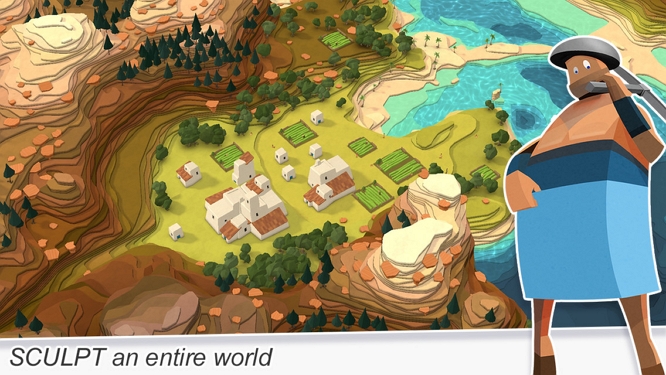
However, 13 years later and now that (most of) the anger has died down and Godus is all but forgotten, is it really that bad of a game? Well, that’s why I decided to write this article. No longer available on Steam (it was pulled a couple of years back now), Godus can still be played on mobile devices, and that’s what I have been doing. Honestly, Godus has problems. The biggest one is that freemium/pay to win model. I’m just not a fan of this idea and don’t think I ever will be. I’d rather just pay for a game outright and get the game. However, under that awful idea, Godus is a very competent God game.

If there is one thing that irks me more than a bad game, it is a good game whose potential is missed and never met. Godus falls into this perfectly. The core mechanics and gameplay are really damn good. The sculping of the land is quite enjoyable. Watching your little people work, grow and evolve is fun. The general idea of the game works, and works well. Godus’ main failing is that awful freemium business model. As far as I understand it, Godus was said to being developed as two different titles. There was this tappy-tap mobile version and all of it’s soul-crushing microtransactions/pay to win model glory, and a “proper” God game or the PC. However, the tappy-tap version took over and the PC version was abandoned. At least, that’s the often told tale. It seems to change depending on who you ask, as some ex-employees of 22 Cans have said that the mobile tappy-tap game was always the main focus sand the PC one was never going to make it to market.

None of that matters now anyway, and nor is it relevant to the point of this article. My point is that Godus is good… if you can ignore the crappy freemium play model. I have been playing the game for the last week or so and I’ve really enjoyed myself. The annoyances come from the intrusive ads, the slow building times, the having to use stickers to unlock new skills, the fact that all of that is built around the idea that you need to use real world money buy gems (the in-game currency) to really advance. This is what ruins the game, not the core gameplay, not the mechanics, the shitty freemium business model.

I don’t claim to know a huge amount of how game dev works, but I know a bit. I’ve been playing games since the late ’70s, I have been running this site for over a decade now. Via this site, I have connected with various indie game devs and publishers. I know that developing a game is not as simple as pressing a button, I know that many, many man hours go into taking a game from an idea to a playable title. But surely Godus is that close to being a proper God game that it wouldn’t take a huge number of resources to get it over the finish line, would it?
The graphics are fine, even after 13 years. They have a nice modern-retro feel. The core mechanics work and the gameplay is there. Would it really take a huge amount of work to remove all the freemium crap and finish Godus as a proper God game? Remove the overly long wait times for building. Get rid of the manual belief collecting and just have it be a pooling system used to advance your people, for building, etc. Keep the unlockable cards that give you new skills and such, and are used as a progression system, but chuck out the stickers needed to unlock those cards.
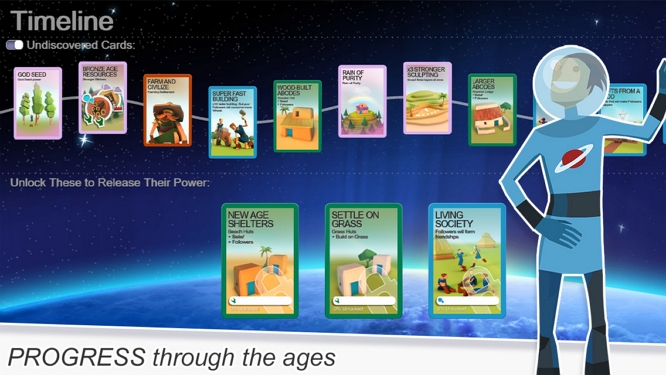
This is what frustrates me about Godus, it is sooooooo close to being a great title. This could be a fantastic return to the God game genre and from the man who created it too. If Godus was finished, and finished properly, it could be one of the greatest game comebacks ever. Cyberpunk 2077 was a mess when it was first released, bugs, glitches and after several delays too, Rightfully, Cyberpunk 2077 was dragged over the coals for it being so shoddy, Wrongfully, death threats were being pushed around social media. It got to a point where the launch was so bad that the game was pulled from sale and refunds were issued. However, CD Projekt Red made a lot of apologies and got to work fixing the problems. Eventually, Cyberpunk 2077 became one of the best and most-loved games in recent years. It has been an amazing turnaround.

Another similar story is No Man’s Sky. Another game that promised a lot and underdelivered at launch. Another game that received a ton of negative backlash and pissed off millions of gamers (even more death threats, what is wrong with gamers?). And yet, it came back from that. The devs have updated and fixed that game too and it is now very much-loved. It can happen, a game can launch and be absolutely lambasted to the point of pulling it from sale and issuing refunds, and it can come back as a rousing success.

The big difference between both Cyberpunk 2077 and No Man’s Sky to Godus is that they are both massive, open-world titles. Godus is tiny by comparison and it would take far less work to get it released as a proper and playable game. Which brings me to my next observation. How much money do you think Godus is making 22 Cans right now? With its freemium play model, it relies on lots of players forking over money for the microtransactions. I was curious myself, so I looked up the recorded player count as of 2025…

One, one person is currently playing Godus in 2025… and that’s me. I know that is me because that bit that says 0 for current players went up to 1 when I refreshed the page after logging back into the game. That 24-hour peak in players, that single player, that’s me. I’m the only person in the world playing Godus and do you know how much money I’ve spent on the game? A whole £0. So I’m going to assume that Godus is making 22 Cans a grand total of £0, daily. If the only person in the world playing the game is not spending any money on it, then the game can’t be making any money, can it?
Do you know how it could make money? If 22 Cans removed all the freemium shit, tinkered with the mechanics and released it as a proper and playable God game. £20 a pop, just to see if they can get people back into it, to see if all is forgiven after 12 years. The return of Godus could work, and I really want it to. I’d love to write an article headlined with, Godus Is Back, And Its Good. I’d love to sing the praises of Peter Molyneux and the team at 22 Cans. I’d love for this to be one of those great gaming redemption stories like Cyberpunk 2077 and No Man’s Sky. It could happen. I know that this is nothing but a pipedream, I know that seeing Godus finished properly and released will never happen… and that is really fucking frustrating because, under all of that freemium bollocks is a very playable God game just screaming to be let out.

Oh, and could someone do a Two Point Hospital job on Syndicate please? One of the finest games ever (I still play it today) and it is desperately calling out for a modern update, that 2012 remake is an abomination and nobody likes to talk about it. Mike Diskett’s Satellite Reign was close, but it didn’t quite hit the spot.
 Little Bits of Gaming & Movies
Please leave a reply/comment.