
I do have to admit to trying to talk myself out of doing The War of the Worlds for a Halloween special this year. Why? because it’s not very “Halloweeny”, is it? When Halloween comes to mind, you think horror icons like Michael Myers, Freddy Krueger, and Jason Voorhees. You think about classic monsters like vampires, zombies, werewolves, or even Frankenstein (yes I am calling the monster Frankenstein, deal with it). You think about scary and (often) bloody horror films. You don’t tend to think about aliens because they feel more sci-fi than horror. Not that the two genres can’t mix, see Alien as proof. Still, aliens are not at the top of the list when Halloween rolls around.

Why I did finally decide to do The War of the Worlds was because, the more I thought about it, the more I remember the 1953 film scaring me as a kid, I remembered how the Jeff Wayne’s Musical Version of The War of the Worlds album was played a lot when I was young, and how my older bother and cousin terrified me with it (I’ll detail that when I get to it). Then, of course, there was the Orson Welles radio broadcast, which was done live in 1938 and on the 30th of October as a Halloween scare. So yeah, I guess that The War of the Worlds can be scary and perfect for Halloween. If it was good enough for Orson Welles…
Anyway, the infamous broadcast and the fallout following it, have gone into the history books. Right here, I’m going to take a look at that broadcast and see if I can work out how and why millions of Americans believed that Martians really had come to take over Earth. Could people seriously have be that stupid? Still, I am writing this the same week in late September 2025 where millions of people (Americans) believe that The Rapture is going to happen. Spoilers, I’m editing this bit after the date given and no, it didn’t happen… obviously.
The Broadcast
Beginning at 8:00 pm Eastern Time Zone on the 30th of October, 1938. The CBS Radio Network broadcast began at the Mercury Theatre in New York, with Orson Welles reading an updated introduction of H.G. Wells’ The War of the Worlds. You know all that bit with us humans being scrutinised by envious eyes as the Martians slowly and surely drew their plans against us. It then becomes a “real” radio broadcast with a weather report and music being played live from a hotel by Ramon Raquello and his orchestra. The music plays for a while, until it is interrupted by a special news report. This report says that several flashes have been observed on Mars and that the radio station will keep listeners updated. In the meantime, back to the music. There’s more from Ramon Raquello and his orchestra for a while. Then, another news interruption with the station saying that they are trying to secure an interview with astronomy professor Richard Pierson (Orson Welles). Back to the music, before that previously mentioned interview is broadcast, in which the professor dismisses any chance of their being life on Mars, so back to the music.

Then we get another interruption, this time to report on a meteorite crash-landing in Grovers Mill, New Jersey. The radio station sends out a reporter called Carl Phillips and the astronomy professor, Richard Pierson to investigate. It then gets into the meat of The War of the Worlds with a Martian emerging from the crashed meteor, mass killing via the heat ray, etc. With everything being described by Carl Phillips and Richard Pierson. The radio broadcast cuts to dead air as an announcer says that there are some “technical difficulties”, with a piano interlude being played. The broadcast resumes and the descriptions of the Martians, human deaths, and eventually, the massive tripod fighting machines. And the show continues, with descriptions what is happening and how the Martians are destroying New York, right up to the aliens dying due to being exposed to our germs. It’s The War of the Worlds.
The Aftermath
It has been said that the broadcast caused unmeasurable panic as millions of radio listeners believed that the show was real and that Martians really had attacked Earth and destroyed New York. In 2013, a TV documentary show called The American Experience covered this very subject and that claimed “Upwards of a million people, were convinced, if only briefly, that the United States was being laid waste by alien invaders”. This documentary features interviews with people who listened to the broadcast when it originally aired. The day after the broadcast in 1938, there were news reports of people believing that the end of the world was imminent. Thousands, millions of people tried to flee, some grabbed weapons and readied themselves to battle the Martians. Fights broke out among neighbours as they tried to get out of the city. Some newspapers even reported on attempted suicides as sacred Americans would rather take their own lives than face death by the Martians. It was utter chaos as mass panic spread across the entire U.S.
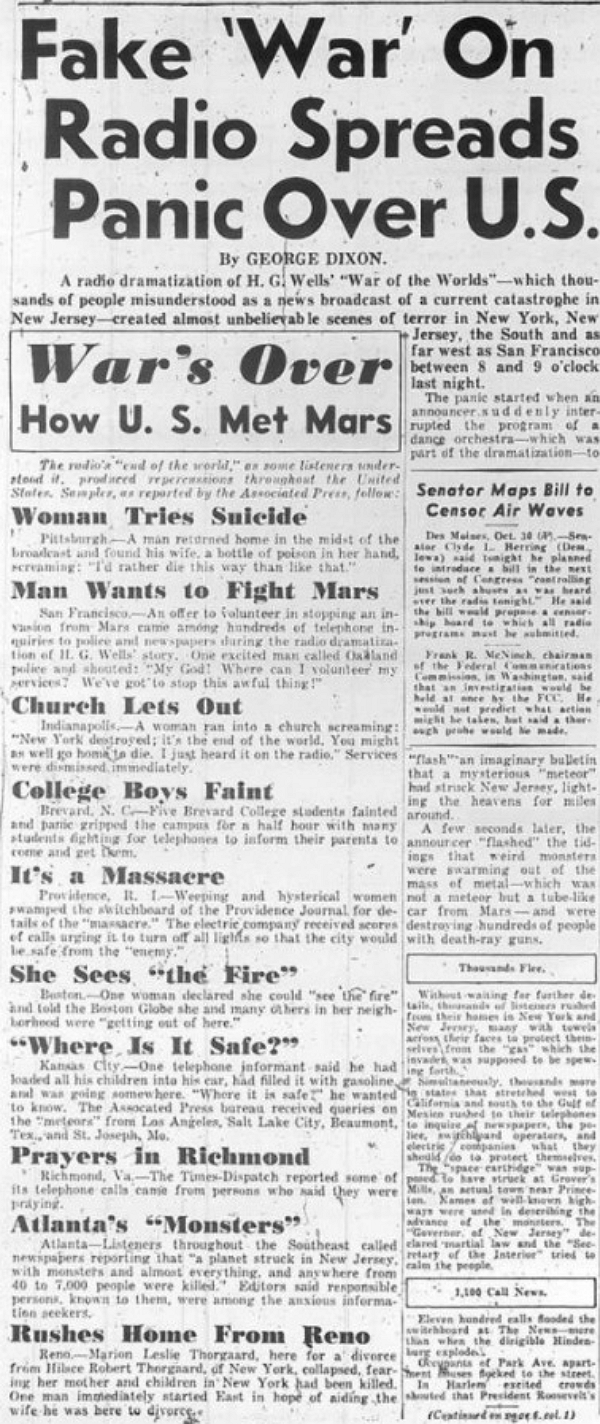
The press headlined their papers with vitriolic backlash and stories of how the show created widespread hysteria across the nation. Threats of lawsuits and calls for strict radio censorship followed. It got to a point where Orson Welles had to publicly apologise for the hoax. He wasn’t just the narrator and an actor in the broadcast, he directed and produced it too. So he was the main target in the sights of the press. However, if the broadcast did anything, it catapulted the then 23-year-old Orson into Hollywood stardom. At the time Orson Welles was little-known, he’d done some stage and radio work, but nobody really knew him as a star. Following this infamous radio broadcast, he was writing, directing, producing and staring in Citizen Kane, as his career exploded and he became a worldwide star. Funnily enough, Paramount Pictures approached Orson with an offer to turn The War of the Worlds into a feature film, he declined.
But, I’m not here to profile Orson Welles and delve into his work, I’m here to ask a question. Did this The War of the Worlds radio broadcast really terrify hundreds, thousands, (possibly) millions of Americans across the country? That’s the story, isn’t it. It’s one of the most famous and infamous tales in broadcasting history. And as I previously touched upon, the press the following day attacked both Orson Welles and CBS over the show.

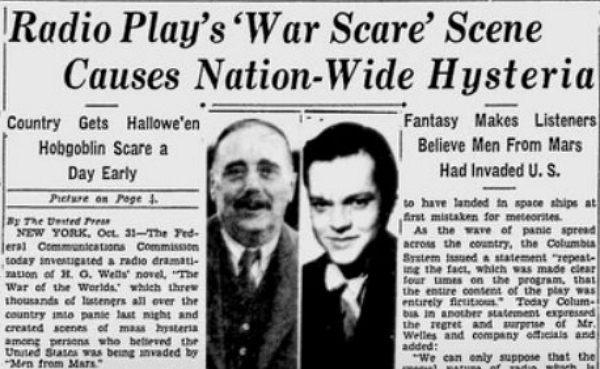

Even with all of those headlines, I have doubts. You see, I’m extremely cynical. Some may see this as a character flaw, I see it as a superpower. I’m not easily fooled. I have my fair share of Internet scams and I get pleasure from stringing them along and just generally messing with the scammers. No word of a lie, I am currently having a several week long email conversation with the world-famous author and film-maker, Michael Crichton. For those not in the know, he’s the man behind classics like Westworld, Jurassic Park, The Andromeda Strain and many others. Impressive, eh? However, the fact that Michael passed away in 2008 seems to have been missed by this particular scammer (so has basic grammar and spelling). I know that this scammer isn’t really Michael Crichton, but they don’t know that I know, and this gives me the upper hand to mess with said scammer.

Anyway, the point is that I’m not easily fooled. I don’t fall for Internet scams, radio hoaxes or end of the world Rapture claims. However, it is 2025 and I personally think it is much harder to fool people with this kind of thing now than it was back in 1938. Surely, we as a people, are a bit more savvy then back when this The War of the Worlds radio broadcast happened. Was it easier to fool people in 1938 than it is today? Possibly… maybe… perhaps. But, my cynicism is kicking in as to exactly how “terrified” the nation was. Can I really believe all of those newspaper headlines and often repeated stories of the mass fallout following the broadcast?
First, a little defence. Public radio broadcasting for entertainment didn’t really become a thing in the U.S. until 1920. Even then, as with most new technologies, it was expensive and not many people trusted it. It took until the start of 1930 for household radios to become the norm as the golden age of radio began to gather momentum. Less than half of the households in the U.S. had a radio by the start of 1930. By the end of the 1930s, more than 80% of homes had a radio. The point being that in 1938 when this famed The War of the Worlds broadcast aired, household radios were massively popular. Even so, radio broadcasts were simple. News, a bit of weather and some easy-listening music. Several drama shows began to be broadcast too. Radios quickly became that sentient family friend that sat in the corner and would entertain the family with wholesome shows. So, nobody was expecting a Halloween trick when Orson Welles took to the air on the 30th of October, 1938.

More defence, this broadcast was very, very well done for the time, and disguising it as a real and genuine, everyday show was genius. The weather report, the news, the music from Ramon Raquello and his orchestra, all perfectly normal stuff for 1938, nothing was amiss. I can see how families would be huddled around the radio for some light entertainment and that they would believe that they were listening to a real broadcast. They had no reason to think otherwise. Then, as I have already mentioned, Orson Welles was little-known at the time, so it’s not like there were any expectations and people would know that it was all an act or any kind of a trick. When I first heard of this famous hoax many years ago, I had not yet listened to the broadcast itself. I always thought it was just Orson Welles sitting there and reading excerpts H. G. Wells’ novel. I couldn’t work out how people thought that it was a real Martian invasion, because it was just a bloke reading a book. Now that I have heard the broadcast, I get it. It was cleverly manipulative and ahead of its time. Updated and hidden in a “real” broadcast that gets interrupted by the news of an alien invasion. Yeah, I can see how people in 1938 may have fallen for it, because nobody was expecting it and nothing like it had ever been done before.

You also have to keep in mind that 1938 was one year before World War II began as the Munich Crisis was ongoing at the time, with Hitler threating to expand Germany’s boarders and declaring war on Czechoslovakia, just a few weeks before this broadcast aired. The threat of war was a very real thing back then. 20 years before this, The Great War (WW I) had ended and there was the long running fear of the Red Scare from the Russians. There would’ve been people alive listening to that CBS broadcast who survived The Great War, and people listening who were very much aware of the Red Scare. War breaking out was a high possibility and many listeners would’ve been on edge already.
However, there are several things that didn’t make sense and make me question how anyone could’ve fallen for it. For instance, the broadcast begins with Orson Welles delivering that updated version of the very famous opening of the book. Surely it was obvious that it was not a real alien invasion because this intro came before anything else. Before the weather report, before the faux news bulletin, before Ramon Raquello’s music, etc. Didn’t people think it was a bit strange that someone read the opening from one of the most famous and popular books at the time… to then cut to something completely unrelated? Okay, I’ve told a little bit of a lie here. The broadcast didn’t begin with Orson reading the updated opening from The War of the Worlds, it began with a declaration that what people were listening to was a dramatization of the book, complete with a mention of H. G Wells specifically, and that Orson Welles was the director and star of the broadcast. So people were told at the very start that it wasn’t real.

Even so, the broadcast had an advertisement break. Would there really be an ad break during a massive alien attack? Not only was there a break, but CBS announcer, Dan Seymour took to the air and stated the following.
Dan Seymour: “You are listening to a CBS presentation of Orson Welles and the Mercury Theatre on the Air, in an original dramatization of The War of the Worlds by H. G. Wells. The performance will continue after a brief intermission. This is the Columbia Broadcasting System.”
So people were told at the start that it was a dramatization of H. G. Wells’ The War of the Worlds, and there was an ad break that said the same thing. Also, the first half may have been broadcast as a “real” show being interrupted by the news and such, but the second half was presented as a normal drama show with time jumps and all sorts. It was blindingly obvious that it was not real. Not only that, Orson himself added a little admission at the end of the broadcast, to further clarify that it wasn’t real.
Orson Welles: “This is Orson Welles, ladies and gentlemen, out of character to assure you that The War of the Worlds has no further significance than as the holiday offering it was intended to be. The Mercury Theatre’s own radio version of dressing up in a sheet, and jumping out of a bush, and saying “Boo!”. We annihilated the world before your very ears and utterly destroyed the CBS. You will be relieved, I hope, to learn that we didn’t mean it, and that both institutions are still open for business. If your doorbell rings and there’s nobody there, that was no Martian, it’s Halloween.”
Even with the several announcements that was just a Halloween tale, people still believed that it was a real Martian attack… really? They must’ve, given all of those previously mentioned newspaper headlines. This is a story that has gone down in entertainment history over the decades. Surely everyone knows that Orson Welles’ re-telling of The War of the Worlds caused mass hysteria across America… right? Well, let me ask, explore and answer that very question.
Was There Really Mass Hysteria?
We have had fairly recent documentaries that back up the claim that this broadcast caused fights, riots and even reported suicides. Yet, none of it seems to be true. The first port of call would be the press that lambasted the broadcast the following day. You remember all of those pictures I used of the various newspapers, right? They weren’t fake, no AI generation (you can tell because the words are spelt correctly). Those were genuine headlines from genuine papers from 1938 after this infamous adaption of The War of the Worlds aired. The press wouldn’t lie, would they? Well yeah, yeah they would. Much like how there are sensationalist headlines in the press today, clickbait crap to lure you in to click on a news site so that they can get that ad revenue. Well, this backlash was manufactured by the press in 1938. This was their version of clickbait.

But why? As I said before, radio was still pretty much new back then and also as mentioned, this War of the Worlds broadcast had an ad break. This is the key, ads. When radio became so popular, it took some of the ad revenue from the newspapers. The more and more popular that radio became, the more and more advertisers wanted a piece of the pie, so they pulled their revenue from the papers and put it into radio ads. This pissed off newspaper publishers and they started their own little war (Press-Radio War) where they would publish outlandish claims to try to discredit radio. Yep, all of those sensationalist headlines about the Orson Welles broadcast were massively overblown, exaggerated and just outright lies to attempt to discredit radio. Now, the Press-Radio War lasted between 1933 and 1935, but this 1938 War of the Worlds broadcast gave the press the perfect chance to stick the knife in and give it a twist. The Press-Radio War may have ended a few years before, but the papers were still pissed off that radio was becoming more and more popular, they saw radio as a lesser form of media, unreliable and underneath them. So the press would take any opportunity to put radio down, and this Orson Welles broadcast dished up the absolute perfect opportunity to do exactly that.
What about that 2013 TV documentary, The American Experience which covered the mass, nationwide hysteria, claimed that “Upwards of a million people” fell for it, and even interviewed people who listened to the broadcast at the time? Here’s the opening 7 minutes from that documentary for you to see yourself. That must be solid proof, right? Not really. This may come as a bit of a shock to you, but not all documentaries are 100% factual, some even fake things for views or to make a point, a mocumentary. If you have seen this documentary (or just the opening 7 minutes), then you’ll know that the interviews are of people in 1938 who had recently listened to the broadcast and were telling their tales of how it fooled so many people and caused mass panic. However, the interviews were fake. The first clue is how crisp and clean the interviews are for being filmed in 1938. They’re widescreen, HD quality. The second clue is this video of outtakes from the shoot. The interviews were with actors hired in 2013, dressed up in period clothing and spouting scripted crap based on newspaper stories about the broadcast. They were not real interviews and it was not a genuine documentary. I guess that they were going for an Orson Welles-like prank?

But speaking of Orson Welles, if there was no panic, why did he apologise for the broadcast? There have been some theories on this. One that he was forced into doing it by the press over the headlines that they made up. During the apology, Orson even says that he hasn’t had time to read the papers because he went straight into rehearsal for another production, and hasn’t stopped since finishing the broadcast the previous night. So he didn’t fully understand what he was apologising for. There is also the belief that Orson orchestrated the “apology” himself to add more fuel to the fire of the hoax. You can watch Orson deliver his following day “apology” here. When you listen to him, he never does sound fully sincere and it doesn’t really sound like a serious apology.
Orson Welles: “I seriously can not believe I’m having to do this.”

Do you know that, aside from the exaggerated press, there are no official records of any mass panic caused either during or after the broadcast? Nothing, zip, zilch, nadda. There’s not one reputable shred of evidence that anything kicked off anywhere in the U.S., large or small scale. No reports of riots, no reports of suicides… other than what was in the newspapers. That’s a bit strange, no? Surely there would be easy to find documentation of such a massive widespread panic taking over the entire U.S. Nope, nothing. This does lead to me as one final question.
Did Anyone Really Fall For It?
Albert Einstein: “Only two things are infinite, the universe and human stupidity, and I’m not sure about the former.”
It’s not too often that I get to quote Albert Einstein on this blog, but this famous quote really seems quite apt here. While it can be proven, with very little doubt, that the press manufactured the mass hysteria and panic over Orson Welles’ infamous radio broadcast, the same can not be said about whether people truly believed that Martians had come to attack Earth on the 30th of October, 1938. But one thing I can say with a certain degree of certainty is that people are stupid. Now, before you feel that I am insulting you, dear reader, maybe you’re not one of the stupid ones. However, en masse, people are stupid. Stickling with the whole alien theme, allow me to use another quote, this time from Agent K from Men in Black.
Agent K: “A person is smart. People are dumb, panicky dangerous animals and you know it.”
Part of me doesn’t think that it would be beyond the realm of plausibility that someone, somewhere fell for the prank. I do think it is possible, just not to the level of mass panic. Another part of me does have to question what kind of idiot would believe that Martians had attacked Earth, just from a radio broadcast. I know it was 1938 and all… but they could’ve looked outside and seen for themselves that nothing had happened. Much like H. G. Wells’ novel, Orson Welles’ adaption used real-world locations. Updated and Americanised, but still real-world locations. I’m sure that the people of New Jersey and New York could see for themselves that there was no alien invasion. What about other locations? They may not have been able to see with their own eyes, but their ears worked. They could’ve changed the dial on the radio and learned that no other station was broadcasting the gargantuan news that aliens are attacking Earth.

But again as both Albert Einstein and Agent K have highlighted, people are stupid. Even so… Martians? If Orson Welles had been telling a story of how Germans or Russians have attacked America, what with the whole ongoing Munich Crisis and the Red Scare thing, I can see people falling for it because it would’ve been closer to home. In very bad taste, yes, but more believable. But Martians? Confession time from me. At one point, I believed that the story described in the Jeff Wayne album really happened. I’ll explain why in the next article. But in my defence, I was a kid around the age of 7 or 8. Kids scare easily and tend to believe a lot of what is told to them. What are the chances of grown adults, listening the the radio an honestly believing what they were hearing?

There’s more. Did you know that very few people even listened to Orson Welles’ version of The War of the Worlds? This kind of goes back to the press massively exaggerating things to discredit the radio. In order to learn how many people tuned into radio back then, they had to contact households and ask what they were listening to. A company called C.E. Hooper collected the data and called it Hopper Ratings. After the broadcast, C. E. Hopper contacted thousands and thousands of households across America and asked what they were listening to on the night of the 30th of October, when The War of the Worlds broadcast was on. The Hooper Rating for Orson Welles’ show was around 2% of the radio listening audience. This was because the CBS broadcast went up against rival NBC’s The Chase and Sanborn Hour. This was a massively successful and popular comedy show that millions and millions of radio listeners tuned in to. By the way, The Chase and Sanborn Hour featured a ventriloquist act, and I have to ask how do you have a ventriloquist act on the radio?
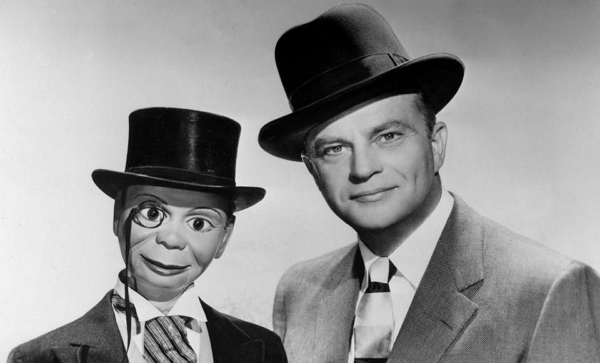
Regardless, The Chase and Sanborn Hour was huge and it totally destroyed Orson Welles in the ratings, it wasn’t even close. Hardly anyone tuned into his War of the Worlds show. It has been said that, when The Chase and Sanborn Hour had an ad break, people may have tuned into CBS and The War of the Worlds. Given that these people would not have heard the show from the start and that they would have missed the disclaimer stating that it was just a dramatization of H. G. Wells’ novel, it is possible that some of them may have believed it was true… possibly? Given the press’ overblown exaggeration of hysteria and panic, and not really liking the news that Hooper Rating showed only 2% of listeners tuned into The War of the Worlds, CBS conducted their own nationwide survey and the results were revealed by a CBS executive shortly after.
Frank Stanton: “In the first place, most people didn’t hear it, but those who did hear it looked at it is as a prank and accepted it that way.”
From what little evidence that does exits, it seems that nobody was fooled and they quite enjoyed the Halloween trick. Even if it was only 2% of listeners that tuned in to Orson Welles’ interpretation of The War of the Worlds, most (if not all) of that 2% got that it was just a dramatization. So definitely no mass panic that spread across the U.S. A few days after the broadcast, The Washington Post published a letter from one reader who walked the streets the night of the broadcast and stated that they saw “nothing approximating mass hysteria. In many stores radios were going, yet I observed nothing whatsoever of the absurd supposed ‘terror of the populace.’ There was none”. The press themselves dropped the story after two days. This itself makes no sense given the severity of the supposed panic. Realistically, the press should’ve had hundreds, thousands of witnesses that could keep them selling papers for weeks with their stories, but they didn’t.
The whole thing is a myth, and a myth that people still believe today. There was no panic, no riots, no suicides. It was all made up by the press, who themselves got bored and dropped the story two days later. I’d normally get rather annoyed at idiots still thinking that Orson Welles’ The War of the Worlds broadcast terrified America and millions of people fell for it, but they didn’t. However, I kind of like that this myth still persists today, I like the idea that a simple radio broadcast of a great story had such a massive impact that has lasted almost 90 years. For me, this shows how great H. G. Wells’ alien invasion story was, and still is.

How about a little bonus trivia? Did you know that Orson Welles met and spoke with H. G. Wells? It was in autumn 1940, almost two years to the day of that infamous The War of the Worlds radio broadcast (that didn’t fool or scare a nation). The two met in San Antonio, Texas, H. G. was in town to address the United States Brewers Association, and Orson was there to host a talk at the town hall. Completely serendipity that these two people, linked by a fictional alien invasion, just so happened do to be in the same location at the same time. A local radio station, KTSA radio learned that Wells and Welles were in town and invited them in for a double interview. They talked about World War II, Orson’s film Citizen Kane, the future and yes, they talked about The War of the Worlds. Even better, that talk was recorded and is available to listen to right here.
By the way, if you do want to listen to the famed Orson Wells broadcast, click here. Looking at it from the perspective of 1938, it’s really well done and one of the better adaptions of the story. But for me, the absolute best adaption of the novel is going to be explored in my next article.
 Little Bits of Gaming & Movies
Please leave a reply/comment.