
The God game genre, created back in 1989 by Peter Molyneux with Populous. One of my favourite games and a genre that I have had a major soft spot for close to 40 years now. Abbey Games and Firesquid present the sequel, Reus 2. A game all about giant God-like creatures that can shape and create entire worlds for civilisations to thrive on.
“Shape worlds with your godly titans. Make symbiotic ecosystems and inspire humanity with your creations. Their achievements unlock new possibilities. Make different planets for different human spirits, and fill the universe with life!”
Originally released on Steam in 2024, Reus 2 is now available on Switch and Xbox. Right from the off, I’ve never played Reus. So, I’m coming into this sequel completely blind. The next thing that I want to bring up is how Reus 2 is both simple and deeply complex. There is a tutorial, but honestly, it is lacking. I think the idea is to let players just experiment and discover what the game offers themselves, but just getting started is quite an obstacle and the tutorial doesn’t do a very good job of explaining the basics. Thankfully, I did find this YouTube video that covers the basics far better and once I’d watched it, I had a greater understanding of how Reus 2 works.
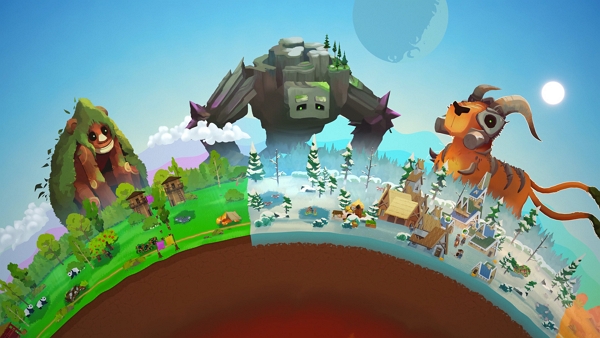
The basics ae that you, as a God, control three giant titans and use them to craft a planet for humans to live on. Each of the three titans specialise in a specific biome, be it forest, ocean, desert, or other. There are more than three giants, but you can only play as three per each world. You do get to select your three giants at the start, out of six, if you have unlocked them. You begin by placing one of the three biomes and having your first group of humans settle. They will build a small settlement to live in. Then, it is up to you to place specific biotica, these are smaller things like animals, plants or minerals, that will shape how your humans and their settlement grows.

Each set of humans will have their own specific goals and traits to help them grow. For instance, the Merchant is money focused and will need you to concentrate on building the wealth of his people. Others will require food so that the population can grow. The Botanist wants specific biotica to make advancements in science, as an example. It’s all gets very micromanagement-like, and this is where the simplicity of Reus 2 mixes with the complexity. The game is simple in that, it can be broken down to three basic staples. Animal, vegetable or mineral, or as translated into the game, population, wealth or science. This is the kind of thing that you learn in school, around the age of 6 or 7. It really is basic stuff. Just pay attention to the requests of your humans and give them what they need, based on the animal, vegetable or mineral (population, wealth or science) thing. Simple.

However, the complexity comes in because, you have very limited space where you can put those required biotica and some forward thinking and strategy is very much needed. Add on the fact that some biotica will have a positive, or negative effect depending on where you place them and if they are next to specific other biotica. You can get boosts if you meet set requirements and these boosts are definitely worth aiming for as they are usually greatly more effective in advancing your people. There can even be some individual nodes to place the biotica on that gives specific boosts to a specific biotica. You do have a lot to keep in mind and procrastinate about, even though everything can be broken down to those three simple elements of population, wealth and science.
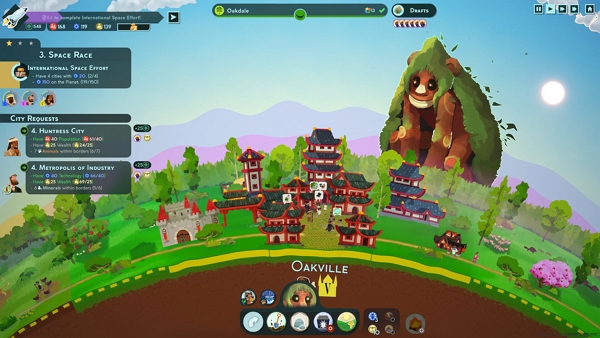
There is no time limit in Reus 2… but there is… kind of. The idea is to advance your humans before the end of each era, the more advanced they are, the better they will do in the next era. Each time you place a biotica in a biome, you use up 5 Eon (or 1 Eon if you are replacing a biotica with another). The game doesn’t advance in “time” unless you spend Eon. Think of it is being turn-based. The way that I saw it was, Eon as in-game currency. Each era starts with you having a set amount of Eon, let’s say 60. So you have to budget what you do using the in-game currency of Eon to ensure that you get the most out of the era you are currently in.

As well as the individual goals for your people and their settlements, you also have a bigger goal to aim for for in each era. You have to juggle between multiple towns, give them what they need to grow, while also keeping an eye on the era goal and trying to ensure that you hit the goal before you use up all of your Eon and advance to the next era. Then there’s the even bigger element of the entire planet. Everything is pooled together, your population, wealth and science, across all of your towns to increase the overall prosperity of the planet. There’s a ton to manage and it only gets increasingly more complex as you progress. You can level up biomes to unlock new and better biotica, advance through eras to unlock new giants and upgrades. You can start and play on multiple planets and fill up a solar system (multiple solar systems) if you wish, or you can just concentrate one one planet.

There’s a decent amount of options to select from as you set up your planet before you begin (and you unlock more as you play). You can make the game easier or harder. You can tinker with the various options and find a comfort zone that will suit your playstyle. As I said, Reus 2 is both simple and deeply complex. The simplicity is how you can really break everything down to those three basic elements, population, wealth and science. But the complexity comes in because Reus 2 becomes a game of 3D chess with you having to balance multiple things all at once and strategize ahead. As I said at the start just watch this YouTube video to get a head start and a great breakdown of how the game works. I’ve not even mentioned the multiple random variables that can occur. Thing like natural disasters, or even your settlements falling out with each other and starting fights, raiding each other and such.

Resus 2 is certainly a packed title and you get a lot of game for your money. Obviously, how much you personally get out of this will massively depend on your love (or loathing) for the God game genre. For me, this one really hit the spot, once I got over the basics and things began to fall into place. However, I do have a gripe, well a couple gripes that all tie into the same overall issue. The user interface is really awkward. As this was originally a PC title that has been converted to consoles (I’ve been playing the Xbox version), the controls are really fiddly and annoying. Right stick rotates your planet, left stick moves around the nodes to place the biotica. Fine, it works. Everything else though is just awful.

There are a lot of icons to click on all around the screen and a lot of smaller sub-menus and info planes to look at. But you can’t directly click on them due to using a gamepad and not a mouse. Instead, you have to press a button (LT, RT or X) to move the cursor to a part of the screen, then press the D-pad (often multiple times) to get to the icon that you want. It’s annoying, it’s really, really annoying. Why you couldn’t just use the left stick to drag a cursor around the screen (like mouse controls) and click on the icon you want, I have no idea. As there is no time limit, you don’t have to make snap, quick reaction decisions, so you are in no rush. Keep the right stick to rotate the planet, use the left stick for everything else. Please devs, give us an update with an option for “mouse controls” using a pad on the consoles (cursor could snap to the icon when it gets near it), it’ll be so much better.

My other gripe is still about the UI. As with any game that was once a PC title that has been converted to consoles… tiny font syndrome. Every PC to console game does this. The font is so small that it is hard to read. It’s fine for PC play when you have the screen three inches in front of your face (in fact, I even streamed from my Xbox to my laptop and could read the font fine), but playing while sitting back in a comfy chair on and a screen the other side of the room, the font is too small to read. Again, this is not a problem exclusive to Reus 2, tiny font syndrome is widespread across PC to console ports. Just give us a slider to increase the size of the font.

Gripes aside, Reus 2 is great game and I’ve very much enjoyed the many hours that I have already poured into it… and I can safety assume I’ll enjoy many more hours after doing this review too. The simplicity and depth juxtaposition works brilliantly and the number of options to tinker with allow you to fine tune the game to your own personal tastes. Once you get into it and master how it all works, you are given a very rewarding and satisfying God game. The lack of a time limit means that Reus 2 is quite a chilled game. Just sit back, relax and take your time. This is is very much on my recommend list.
 Little Bits of Gaming & Movies
Please leave a reply/comment.