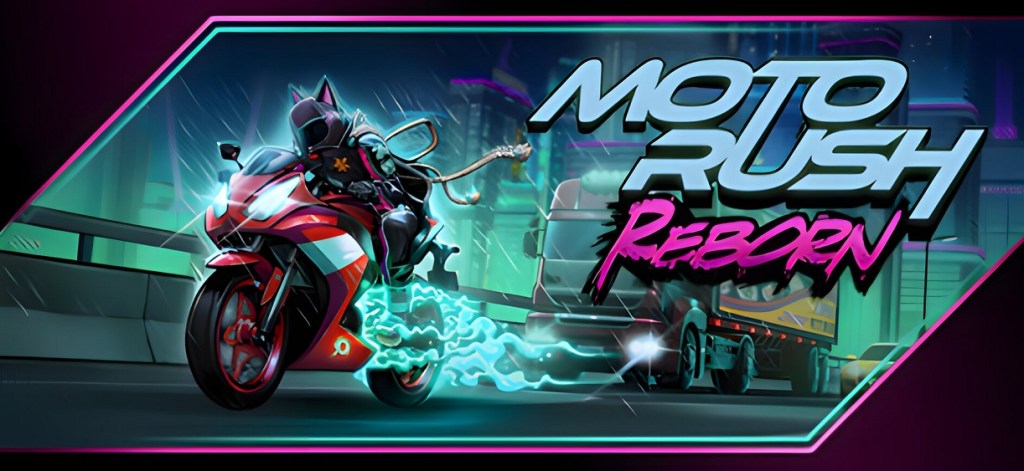
Have you ever played a racing game that’s not quite a racing game, but is still about racing and going fast? Well, Moto Rush Reborn from Baltoro Games is exactly that. You race, very, very fast… but you’re not racing in the traditional sense.
“Rip through retro-futuristic Tokyo highways in a demonic pursuit of speed and power! Lane split through heavy traffic and dominate tracks filled with obstacles on an action-packed mission to overcome possession. Are you fast enough to outrun your demons?”
Moto Rush Reborn opens with a premise that’s knowingly absurd yet strangely compelling: after wrecking your bike in a previous race, you scavenge a replacement from a junkyard… only to discover it’s possessed by a demon. It’s a pulpy, tongue‑in‑cheek setup, but it’s also the key to understanding how the game plays. Because of this demonic hitchhiker, you don’t control your bike like a traditional racer. There’s no throttle, no brake, and no comforting sense of mechanical stability. Instead, the bike behaves like a runaway creature, constantly accelerating, constantly pushing you forward, constantly daring you to keep up. Moto Rush Reborn feels far closer to an endless runner than a conventional racing game, except with one crucial difference: these runs do end. Each stage is a self‑contained sprint from A to B, and the challenge lies in surviving the chaos long enough to cross the finish line.
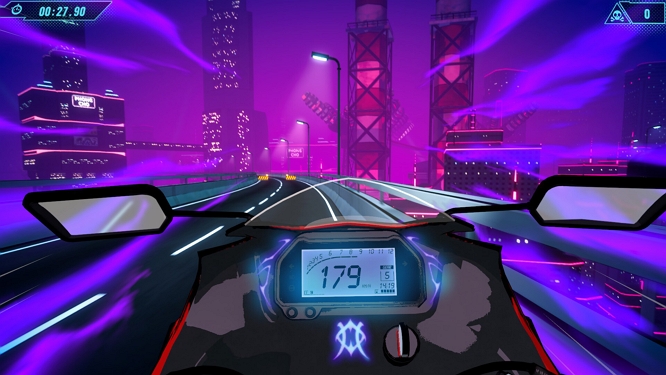
Across its 45 stages, the game builds difficulty with a surprisingly elegant curve. Early levels function as a gentle onboarding process, letting you get used to the unusual controls and the game’s rhythm. But it doesn’t take long before the training wheels come off. Traffic thickens, obstacles multiply, and the road becomes a gauntlet of split‑second decisions. You’ll be carving between cars, threading through impossibly narrow gaps, and praying your reactions are still sharp enough to keep up. Crashing, and you will crash… a lot, sends you back to the last checkpoint. It’s punishing, but never unfair, and the short stage length means failure rarely feels like a setback. Instead, each crash becomes part of the learning loop, a nudge to refine your muscle memory and push for a cleaner run.
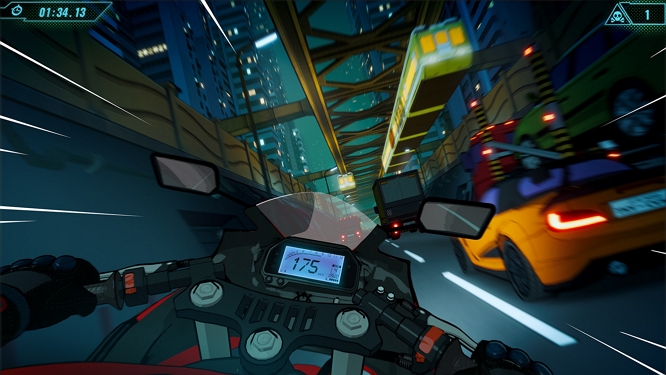
The absence of a traditional accelerate/brake setup is the game’s boldest design choice, and it’s surprisingly intuitive once it clicks. You can speed up or slow down, but not in the way your instincts expect. Wheelie/boost. A single button tap pops the front wheel up and slingshots you forward. It’s exhilarating, but it also drastically reduces your steering control. Every boost becomes a gamble: shave seconds off your time, or lose control and slam into a lorry. Slowdown/glide. There’s no hard brake. Instead, you ease off the speed with a gentle, almost floaty deceleration. It’s more like leaning back than braking, and it takes a few stages to recalibrate your expectations. This risk‑reward dynamic is the beating heart of Moto Rush Reborn. To get the best times, you must boost, but boosting is also the fastest way to die. It’s a constant internal argument between greed and survival.
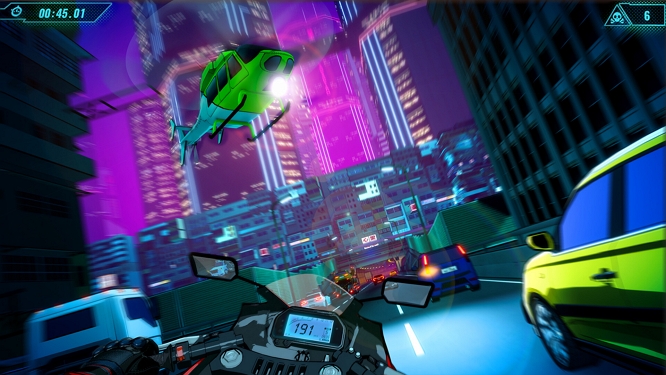
Because acceleration is automated, your attention shifts entirely to the environment. And the game throws a lot at you: low tunnels that force you to duck, barriers and bollards that require a quick slide, jumps that demand precise timing, tight gaps that punish hesitation. It becomes a kind of obstacle ballet, a rhythm game disguised as a racer. Stages are short (usually 2–3 minutes), which encourages replaying them until every hazard is etched into your brain. It’s all about flow: learning the sequence, executing it cleanly, and then pushing for perfection.
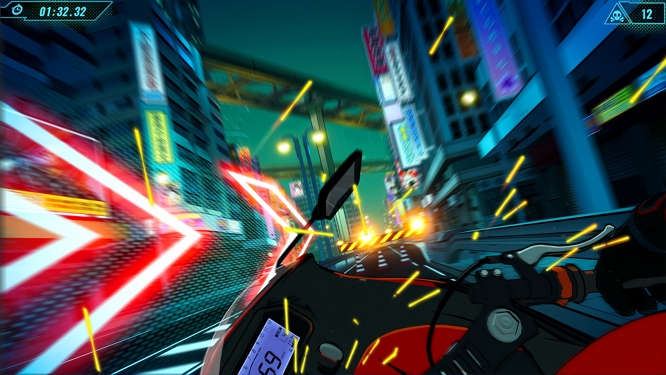
Each stage contains a handful of icons to collect, and their placement becomes increasingly devious. Early ones sit politely in the middle of the road. Later ones hide behind barriers, float mid‑jump, or lurk in spaces so tight you’ll swear the developers are mocking you. Collecting them unlocks panels in a manga‑style comic that tells the game’s story, a charming touch that gives the chaos a bit of narrative flavour. Then there are the near‑miss challenges. Each stage asks you to skim past traffic as closely as possible, which is equal parts thrilling and terrifying. It’s another mechanic that pushes you to ride the razor’s edge, tempting you into danger for the sake of a perfect score.
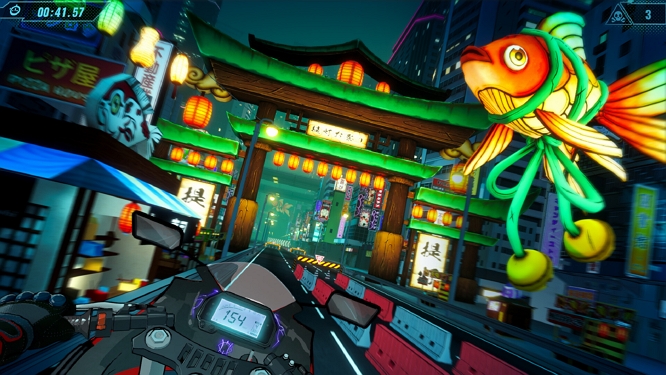
I did have a couple of personal frustrations. First, no control rebinding. All actions are mapped to face buttons, and you can’t change them. For anyone who’s spent decades using triggers for acceleration and braking, this feels unnatural. My fingers kept instinctively reaching for the triggers whenever I wanted to boost or slow down. It’s a small thing, but it adds friction where there shouldn’t be any. Second, auto‑steering on bends. The game handles gentle curves automatically, and I never fully adapted to it. I understand the intention, keep the player focused on obstacles rather than cornering, but it sometimes works against you. More than once, I lined up a perfect dodge only for the auto‑steer to nudge me into the back of a car. It’s a design choice that makes sense on paper but feels intrusive in practice. An option to disable it would be ideal for those who prefer a bit more control.
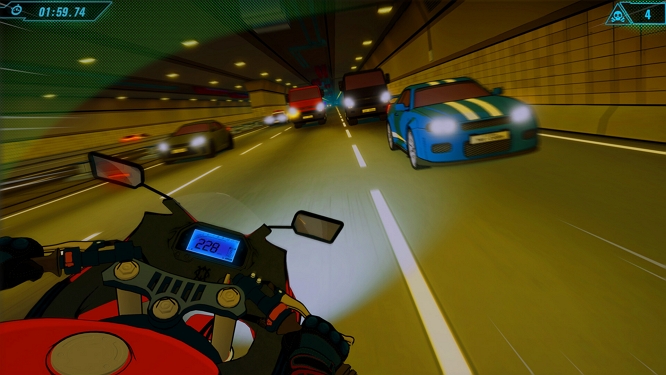
Released on the 20th for PC, Xbox, and Switch at around £12, Moto Rush Reborn is a surprisingly addictive blend of speed, chaos, and precision. It demands fast reactions, faster than mine, these days, but it rewards persistence with a satisfying sense of mastery. The thrill of threading through traffic at breakneck speed is matched only by the fury of crashing inches from a checkpoint. Yet even the failures feel constructive. Every run teaches you something. Every crash sharpens your instincts. It’s simple, stylish, and tightly designed. The short stages, escalating difficulty, and constant push for perfection create a loop that’s hard to put down. Moto Rush Reborn may not be a traditional racer, but it’s a hell of a ride.
 Little Bits of Gaming & Movies
Please leave a reply/comment.