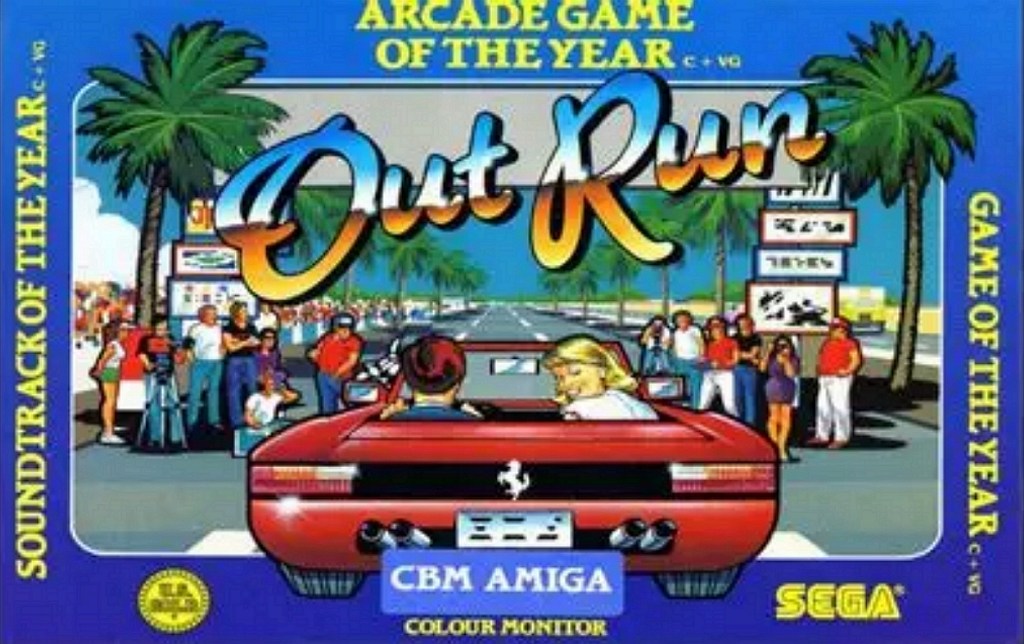
Every now and then, I like to punish myself. Some people run marathons. Some people climb mountains. I, however, choose to replay every home port of Out Run, a decision that sits somewhere between self‑flagellation and historical preservation. This is part of my 40‑year anniversary celebration of Sega’s iconic racer (first article is here), and I decided to track down as many (maybe all) ports of the original game as humanly possible, play at least one route on each, and document the emotional damage. Some ports I already owned. Others required… let’s call it “creative archaeology.”
I’m starting with the 8‑bit and 16‑bit home computer ports, saving the consoles for part two. But before diving into the murky waters of compromised computer conversions, I need a baseline, the arcade original. Oh, I’ll link to any gameplay footage of each game too. This won’t be my gameplay, so an advance thanks to those YouTubers whose videos I do use.
Arcade
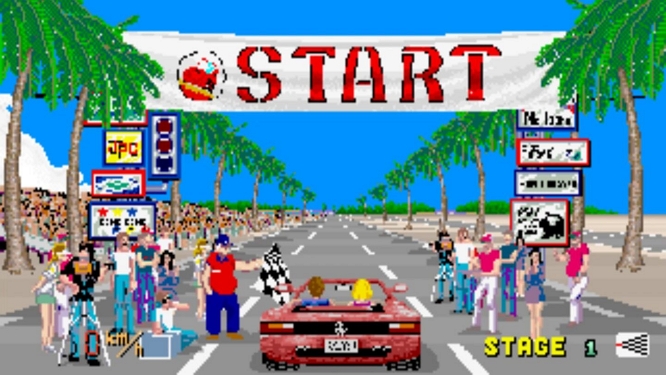
Even now, four decades later, the arcade version of Out Run remains a masterclass in pure, distilled driving joy. As a kid in 1986, I thought it was magic. As an adult, I appreciate the craft, the ambition, and the sheer vibe Yu Suzuki and AM2 managed to bottle. I understand the “passion of driving” that Suzuki was aiming for.
The sprite work is still beautiful. Early 3D polygons age like milk; good sprites age like wine. Out Run’s visuals remain crisp, colourful, and unmistakably stylish. The music? Legendary. The sense of speed? Still thrilling. And the gameplay is top-notch. Out Run is a classic in every sense of the word. It is, of course, the best version of the game ever released… or is it?
Commodore 64 (Original)
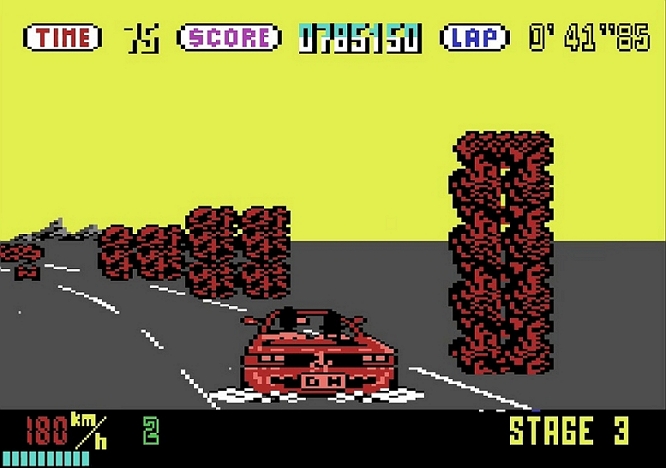
I covered the development of this port in a previous article, and revisiting the game now is like meeting an old friend who looks a bit rough, but still aged surprisingly well. As a kid, I was disappointed; it wasn’t on par with the arcade. But today? It’s a perfectly decent racer. Chunky C64 graphics, muted colours, missing features (no route selection), but a solid sense of speed and genuinely good SID renditions of the soundtrack. A British teenager made this. And honestly? He did alright.
Commodore 64 (US)
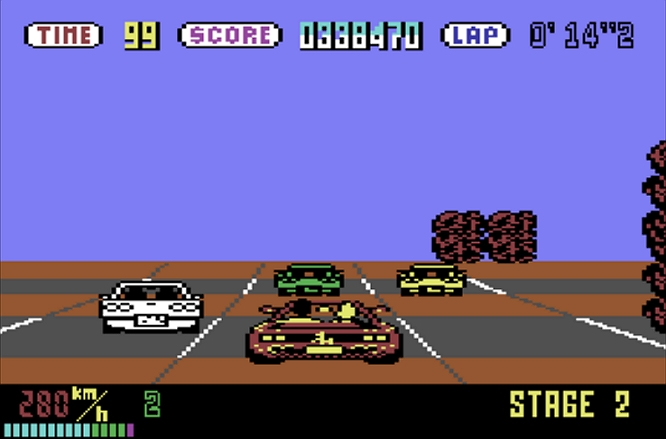
Yes, there were two C64 ports. Because why not? Both were developed by the same person too (see my article link above). This one tweaks the visuals and sound effects. Some say it looks better, more colourful, though occasionally a bit too yellow, if you ask me. The car sprite in the original is nicer, in my opinion, if a little “plump”. Gameplay-wise, they’re nearly identical. The US version is a touch smoother, but for me, I still prefer the original port. It just feels more… Out Run.
Amstrad CPC
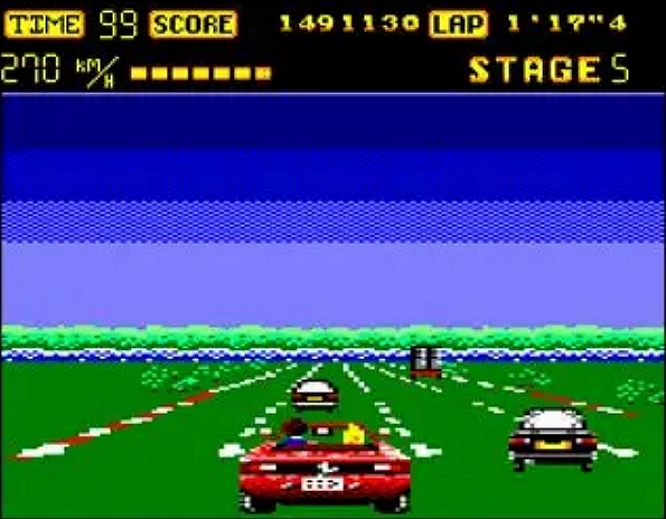
This one is a rollercoaster of a port. Visually? Surprisingly good, aside from the radioactive green road. The car looks great, the colours pop, and in screenshots it’s arguably the best-looking 8‑bit port so far… and then you start to play.
It’s slow, it’s jerky, it’s practically unplayable. Road signs on the right are mirrored for reasons known only to the programmer. If the roadside signs tell you a left turn is coming, it’s a right. “Checkpoint” is written backwards like it’s trying to summon a demon. And the sound? There is no audio other than the “sound” of tyres on the road as you turn. There’s no engine sound, there’s not even any music. The music was a big selling point of Out Run, and some of the home ports had some great renditions. The Amstrad? Silence. Okay, so that is a wee bit of a lie. This port did have music… on a separate cassette tape, which you were meant to play on your stereo while gaming.
One could blame hardware limitations for this being such a bad and clunky port, but this wasn’t a hardware limitation. This was just bad programming. If you need proof, look at Chase H.Q. on the same machine; it’s one of the best home ports of the game.
ZX Spectrum
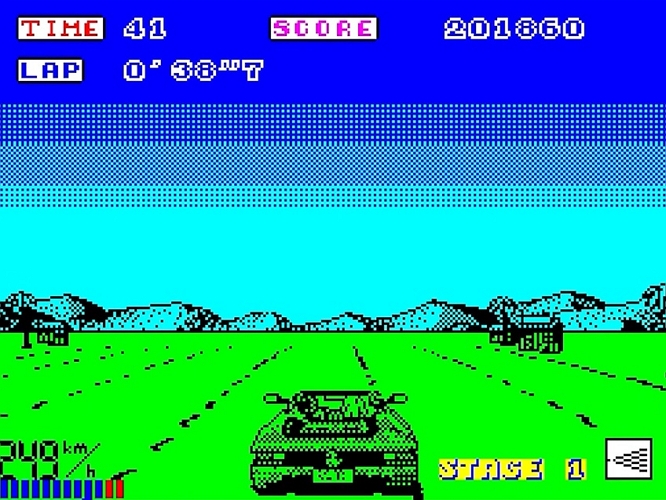
The Speccy was never much of a looker when it came to games, but it often delivered where it mattered: gameplay. Out Run on the Spectrum is… very slightly less terrible than the Amstrad version. The standard of the Spectrum is here, monochrome graphics, but quite detailed. What about the gameplay? I’m pretty sure this was a port of the Amstrad version, or the Amstrad as a port of this. It’s clear it’s the same code as it has identical menus and presentation to the CPC version.
The Speccy version does have music and sound effects, which already puts it ahead. But it runs at the pace of a hungover sloth. The speedometer may claim 249 kph, but the screen says 12. Still, between this and the Amstrad one? The Speccy just about wins by a nose hair. But both are really terrible ports. Honestly, for the Speccy, the music is pretty great.
MSX
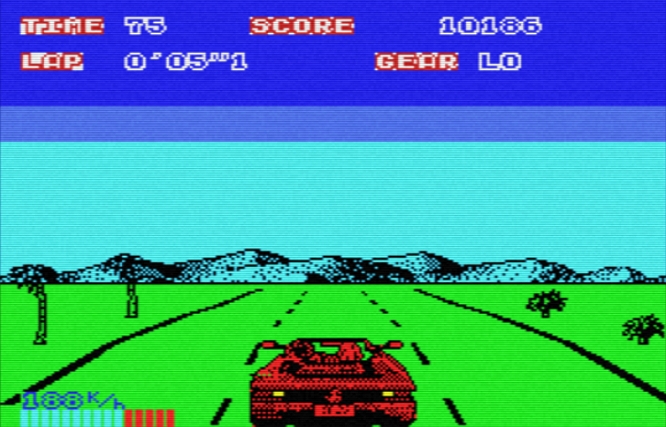
The Amstrad version was bad, the ZX Spectrum was slightly better, but still bad. This MSX port doesn’t say “hold my beer”, it asks you to keep watch over an entire brewery. Again, we have the same code as the CPC and Speccy ports. In fact, this looks almost identical to the ZX Spectrum version, just with a red car.
It honestly looks fine when nothing is moving. The moment you accelerate, the moment the car moves, the road in the distance warps like a collapsing wormhole. Collision detection is deranged. There’s no sound except when you crash, and this is awful. The only real audio is one of the classic music tracks: Magical Sound Shower. The most recognisable tune of Out Run, and this version is just barely passable. It’s like a slightly worse ZX Spectrum tune. The driving itself is painfully slow. This might be the worst 8‑bit port so far, and given the Amstrad and Speccy versions, that’s a bold claim to make. The frame rate and speed are so sluggish that this is less like Out Run and more like Out For A Casual Stroll.
MSX 2
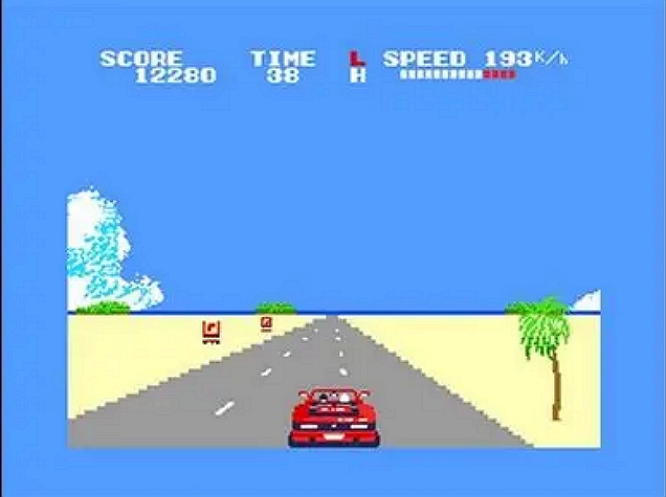
Oh yeah, there was another MSX port of Out Run, this time on the machine’s successor. You’d think this would be the same as the MSX port, just with more colours. Nope, it’s a totally different game. Thankfully, we finally break free from the Speccy coding. Honestly, for an 8-bit home computer, it looks pretty good. Colourful, NES‑like visuals. Recognisable music that’s quite good. Decent speed and the gameplay is smooth. There are actual sound effects too. You even get the animated endings. I do have a gripe. There’s only ever one or two traffic cars on the road, likely a hardware compromise, and the handling feels like driving on ice. The car doesn’t steer, it slides. But compared to the horrors I’ve just endured, this is practically a masterpiece.
Okay, that’s it for the 8-bit computers… computers, before anyone jumps down my throat. The console ports are coming in part two. But now, I’m moving on to the 16-bit computer ports.
Atari ST
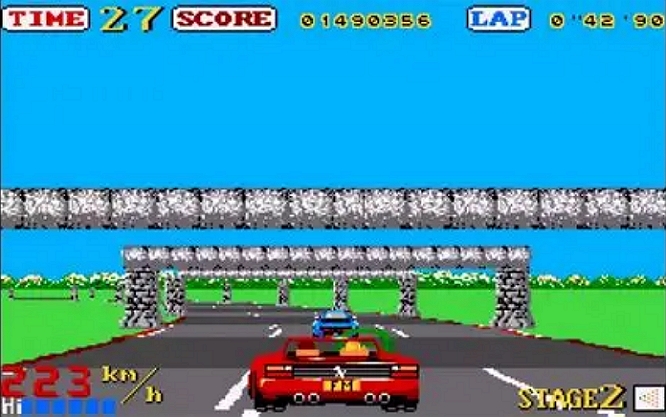
Oh dear, now we’re really getting into the shit. This ST port is horrendous. I believe that it is based on the Speccy code, just with “improved” graphics. I say that because, in terms of gameplay, they are identical, just with “better” visuals and it being a bit faster. The Atari ST could handle smoother and faster racers than this, and I put this down to lazy programming. They had the Amstrad/Speccy code and just used that instead of coding from scratch. It’s pretty obvious.
In terms of a still screenshot, it looks okay, you can clearly tell it is supposed to be Out Run. A slightly rougher version, but still unmistakably Out Run. But it plays terribly. Slow and jerky. Really, really bad music that sounds more like the 8-bit ports. In fact, I think it is the exact same music from the ZX Spectrum port. This is just the Speccy version with slightly “better” graphics, isn’t it? I wasn’t expecting an arcade-perfect conversion, but the Atari ST could do much better than this. This version is so bad, it makes some of the 8-bit ports look good.
Now, logically, I should move on to the Amiga port from this one, for reasons that will become very obvious when I get to it. But I want to save that for last, as I have quite a lot to say about that version. There are only three 16-bit home computer ports anyway. So before I do get to the Amiga version…
MS DOS
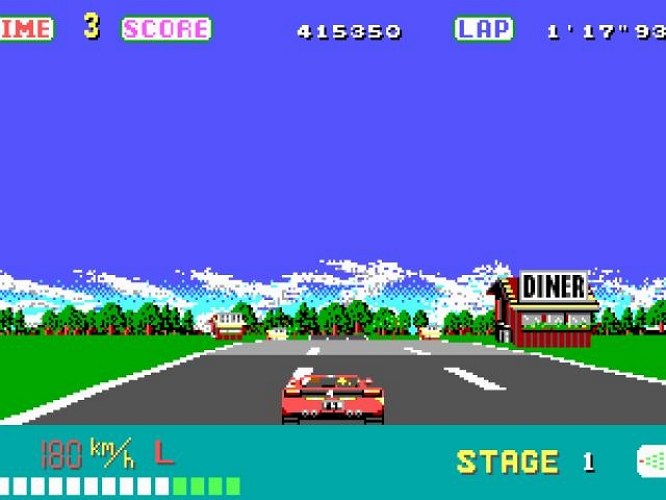
I have to be honest, I didn’t even know there was a DOS version of Out Run until I did this. Let me get the bad out of the way, the music and sound. We are talking early PC gaming here, years before soundcards, so games back then used the internal PC speaker… and they were all awful. It’s like going back to Atari 2600 sound and music. Out-of-tune bleeps and bloops. This version absolutely destroys the Out Run music. As bad as some of the 8-bit ports were when it came to music… they didn’t make your ears bleed like this DOS version.
In terms of looks and gameplay? It’s pretty good. Again, we are talking about early PC gaming, and the hardware was very limited, as PCs back then weren’t built for gaming, and what we have is limited to 16 colours, EGA graphics. But it looks quite good; it looks like Out Run. It reminds me of a better-looking MSX 2 version. It’s smooth and fast, and there are more cars on the road (unlike the MSX 2 port). It plays fine, and this is, by far, the best 16-bit port. The Atari ST could’ve done this, only better. And now, I can’t put it off any longer…
Amiga 500
Before I get into this port, a very brief history of my gaming machines up to this point. We, as a family, had an Atari 2600. In the mid ’80s, we upgraded to a Commodore 64. Later, my older brother bought an Amiga 500. This was my gaming journey in the early years, these are the machines I grew up with and played on. We had Out Run on the C64. It was far from arcade perfect, but it was still a speedy, playable racer. We had Out Run on the Amiga…
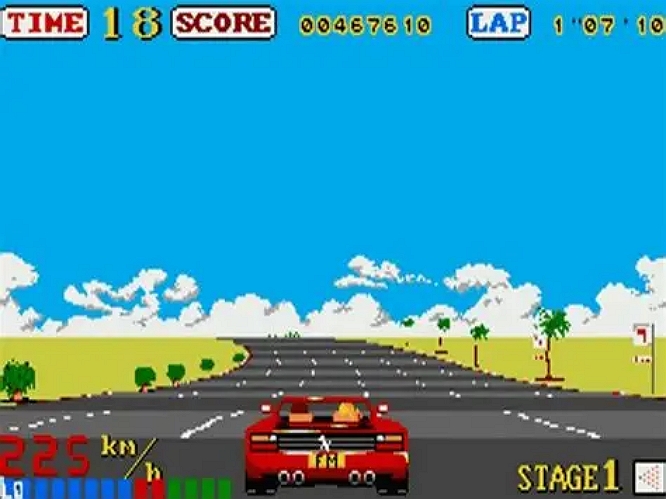
No, no, I have not accidentally reposted a picture from the awful Atari ST port… that is Out Run on the Amiga. Another quick bit of history. Many people think the “console wars” began with the SNES and Mega Drive, the 16-bit consoles. Nope, the console (sometimes computer) wars existed years before then, going back to the Atari 2600 vs the Intellivision, vs the Colecovision. They continued with the 8-bit computers and the ZX Spectrum vs the Commodore 64 (nobody cared about the Amstrad CPC). The war spilt over into the 16-bit home computers with the Atari ST vs the Amiga 500. To this day, the Atari ST vs the Amiga 500 is still fought by some older gamers. There was a genuine bitter rivalry between fans of both machines back then, and having the best port of the best arcade racer at the time earned you massive bragging rights. This is why I felt I needed to leave the Amiga port until last… because it is just a lazy port of the ST version… which itself is a lazy port built on the Speccy version.
The Amiga could and did do far better racers than this awful Out Run port. Take a look at the brilliant Lotus games, or Jaguar XJ220 running on the same computer. They were smooth, fast, immensely playable. So what did Amiga owners get as a port of one of the greatest arcade racers ever? A shitty port of a shitty port based on the ZX Spectrum coding. I can even prove that the Amiga port of Out Run could have been so much better, because a far, far better port has been made by a fan, and here it is…
That’s running on an Amiga. It’s fast, it’s smooth, it looks like the arcade version… perhaps slightly less colourful. But the gameplay is there, the graphics are there. That’s what the Amiga could do. But, instead, we got a shitty port of a shitty port. Now, of course, that fan-made version isn’t running on native Amiga 500 hardware. I’m sure there’s some behind-the-scenes trickery going on. But the fact remains that the Amiga could do better arcade racers than the lazy port it got. Again, see the amazing Lotus and Jaguar XJ220 games.
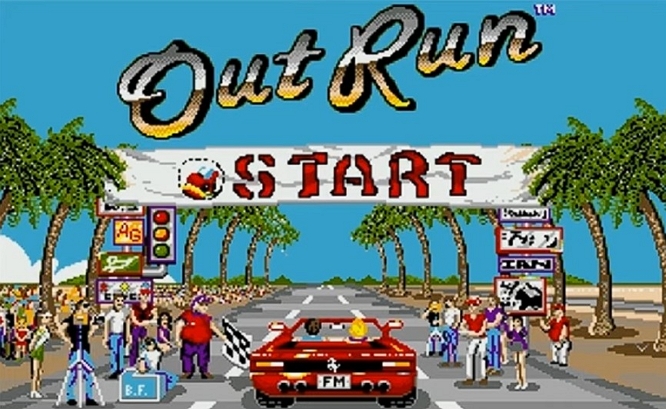
But, there is something else I want to bring up about the Amiga port, the loading screen and the introduction. The loading screen looked arcade perfect, or pretty damn close to it (see above). When you compare it to the game itself, it’s clear it was intentionally misleading. Pretty much all of the home computer ports were guilty of this. They all had misleading loading screens that looked really good, only for the game itself to be a massive visual let-down. But the Amiga version did something on top of that; it had the most ridiculous, over-the-top introduction ever. You got this stupid, booming voice proudly proclaiming “U.S. GOLD PRESENT, FROM SEGA”, followed by an overly long and really annoying music cue/fanfare, then that voice coming back to say “OUT RUNNNN”, like a discount Barry White with a touch of the flu. The intro makes out that you’re about to get the best version of Out Run ever… only to give you the shitty Atari ST version.
Notice that I haven’t linked to any gameplay footage of this port… yet? That’s because I wanted to save it for this bit so you could all “enjoy” it in all its awful glory…
That’s part one: every home computer port of Out Run, played, survived, and documented. In part two, I’ll be tackling the console ports, which range from “surprisingly good” to “why does this exist?” Wish me luck. I’ll need it.

 Little Bits of Gaming & Movies
Please leave a reply/comment.