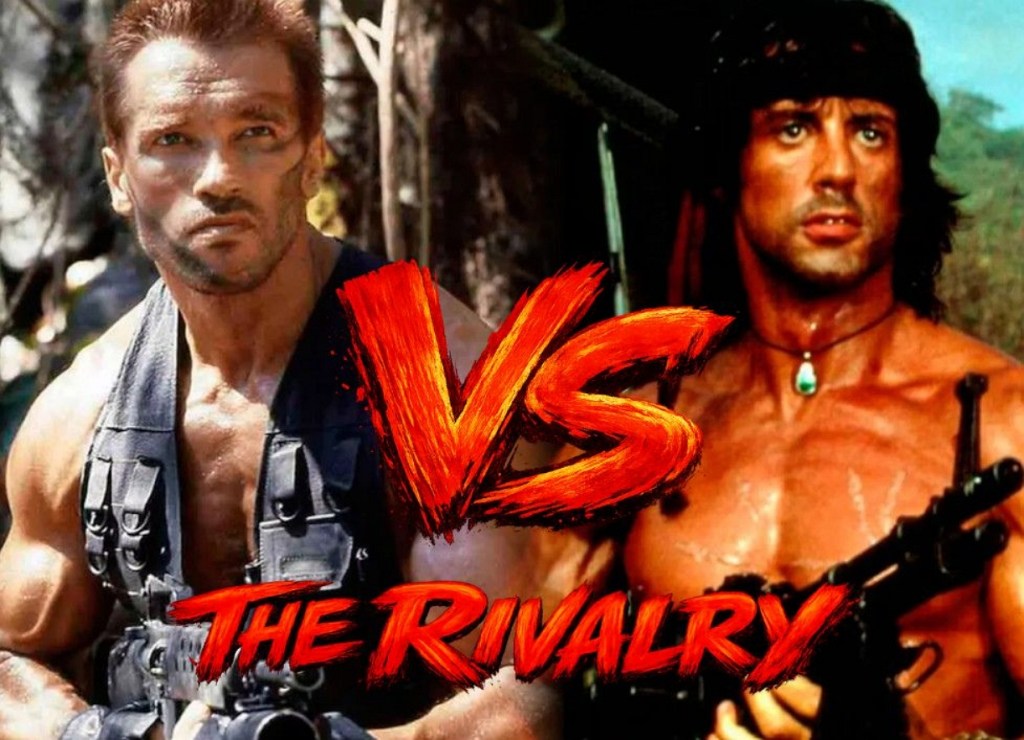
Today is my 50th birthday. I was a July baby, and as it happens, so were two other fairly well‑known blokes: Arnold Schwarzenegger, who turns 79 on the 30th, and Sylvester Stallone, who was 80 on the 6th. So, as a triple birth‑month celebration, I’m taking a look at one of Hollywood’s greatest rivalries, a decades‑long flex‑off between two men who defined an entire era of cinema.
For a generation of filmgoers, Arnie and Sly weren’t just action stars; they were the action stars. They were the blueprint. The poster boys. The reason VHS stores saw a surge in popularity in the 1980s. They were (and in some ways still are) the world’s greatest action movie stars. Several years ago, both Arnold Schwarzenegger and Sylvester Stallone returned as the characters that made them famous in the ’80s with Terminator: Dark Fate and Rambo: Last Blood, respectively. It was in the 1980s that both of these muscle-men became massive successes in Hollywood as they both appeared in similar films for similar audiences, both trying to become the most famous and popular action star in cinema, both wanting the biggest box office hits, they were sworn enemies with biceps.
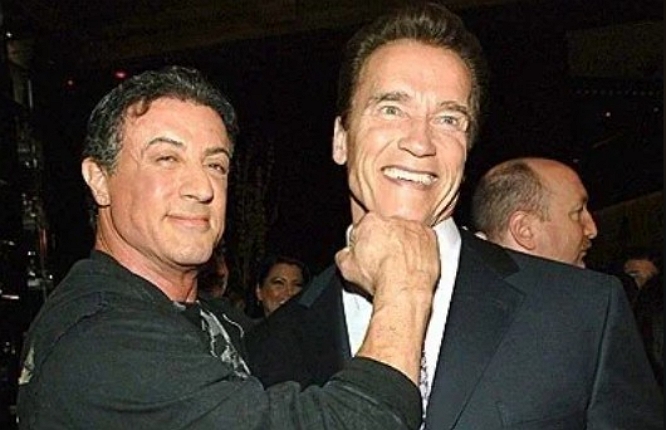
These days, Arnie and Sly are very close friends and have even shared the same screen more than once, but it wasn’t always like that. They used to be bitter rivals and even hated each other at one point. It was the 1980s when their rivalry really came alive, but it all began in the mid-’70s when Arnie was trying to make a name for himself in films while Sly already had a foot on the ladder thanks to his multi-Oscar-winning flick, Rocky.
Their rivalry is a story of ambition, ego, insecurity, success, sabotage, and eventually, something resembling brotherhood. And I’m going to go through it round by round and see who really came out on top.
Round One
In the late 1960s, before either of them were blowing up helicopters in slow motion, both Arnie and Sly were just two fellas trying to claw their way into an industry that didn’t really know that they existed.
On one side, you had Arnold Schwarzenegger, already a big name on the bodybuilding circuit, a genuine phenomenon in that world. He’d been winning contests left, right and centre in the late-’60s, not just in bodybuilding but in powerlifting and weightlifting too. The man was basically a walking anatomy chart. But as much as he enjoyed hoisting trophies and flexing for crowds, Arnie wanted more. He wanted to be a movie star. Hollywood, however, wasn’t exactly rolling out the red carpet.
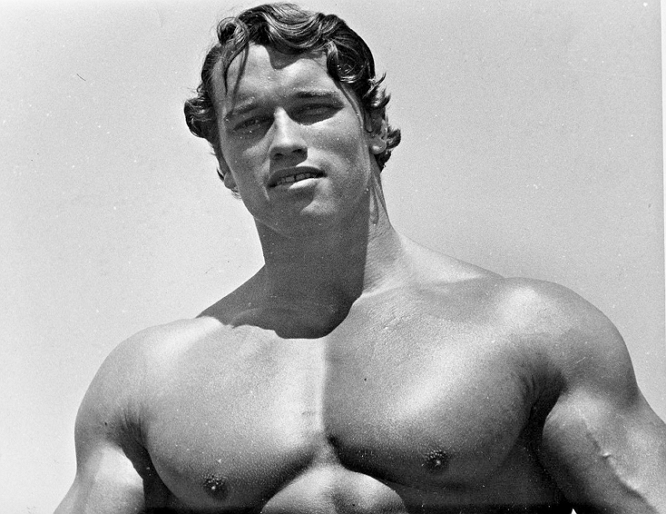
In 1970, Arnie won the Mr. Olympia contest, becoming its youngest ever winner at just 23. That alone would’ve been a lifetime achievement for most people. But the year before, in 1969, when he was 22, Arnie took his first proper swing at acting with Hercules in New York, credited under the name “Arnold Strong”, which is about as subtle as a brick through a window. Have you ever seen Hercules in New York? It’s a really awkward “comedy” that is not funny, except on the “it’s so bad it’s funny” scale. Most of the intended comedy is a massive misfire, and most of the laughs come from unintentional comedy. For some reason, the dubbing of Arnie’s voice is far worse than his actual speaking voice. It’s the kind of film you watch once, then immediately question every life choice that led you there.
Filmed in 69, Hercules was eventually released in February 1970, and while the film was Arnie’s first acting role, Sly already had several film appearances under his belt by then, just not the kind you brag about or really notice.
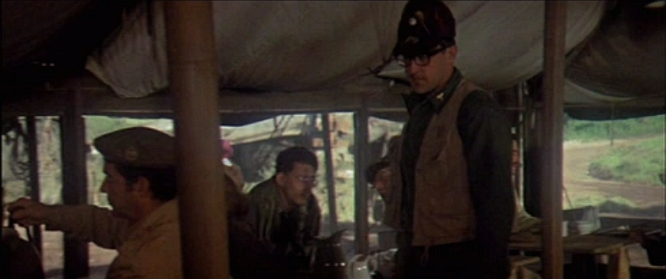
Stallone had been knocking around in the background of films, mostly in small and uncredited extra roles. He pops up in the original movie version of M*A*S*H*, for instance, but you’d need a magnifying glass and a lot of patience to spot him (or just look at the image above). His most infamous role in 1970 was in the very softcore porn flick The Party at Kitty and Stud’s. It’s one of those films that gets brought up in interviews with a smirk and a raised eyebrow, but for Sly at the time, it was less “gateway to Hollywood” and more “I need to eat”.
Sylvester Stallone: “It was either do that movie or rob someone, because I was at the end, the very end, of my rope.”
Both Arnie and Sly were struggling to land any major roles and were barely making it as actors. Arnie had to make a living taking part in bodybuilding competitions and by running a bricklaying business with his friend and fellow bodybuilder Franco Columbu. Meanwhile, Sly was homeless and living in a bus station when he did The Party at Kitty and Stud’s for $200. Two future megastars, one laying bricks, the other doing a very softcore skin-flick to survive. Not exactly the glamorous origin story you’d expect.
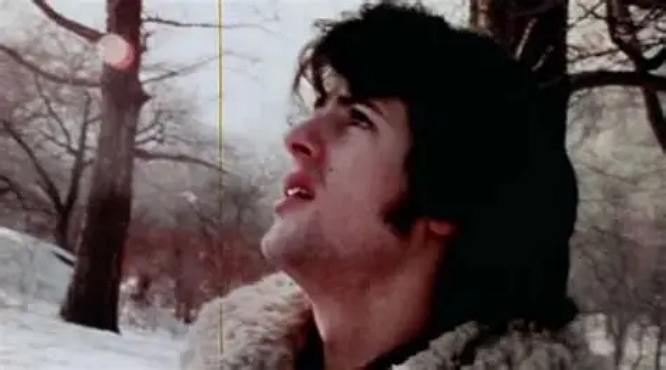
And that’s what makes this first round so fascinating: both men were hungry, both were hustling, both were willing to do whatever it took, but they were doing it in very different ways. Arnie was building a body and a bricklaying business. Sly was building film experience via very small background roles… and really soft porn. As truly awful as Hercules in New York is, at least Arnie wasn’t doing crap softcore films. On the “dignity scale”, being badly dubbed as a bargain‑bin Hercules just about edges out thrusting your way through a “porno” for $200.
So, for this opening chapter in their careers, the “before they were gods” era, I think Arnie wins round one.
Round Two
While neither Sly nor Arnie made much of an impression in the acting world by the time the 1970s began, Sly definitely had the edge in terms of sheer experience. He’d been hustling for years, stacking up small roles, blink‑and‑you’ll‑miss‑him appearances, and the occasional “please don’t put this on my IMDb page” job. Arnie, by comparison, had only three acting credits by the time 1976 rolled around, one of which involved him wrestling a man in a bear suit in Central Park.
But their rivalry, the proper, fiery, ego‑driven, “I can’t stand that bloke” rivalry, wouldn’t ignite until 1977, at an awards show that should’ve been a celebration but instead became the first proper clash of the titans.
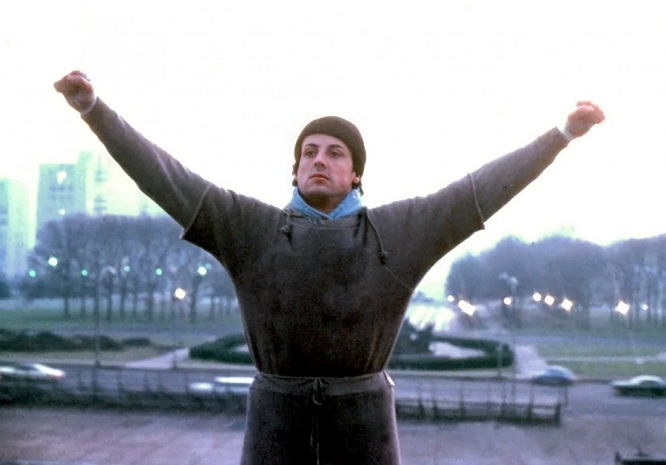
By ’76, Sly had racked up 16 acting roles. None of them were particularly outstanding or notable… until he wrote and starred in Rocky. And Rocky wasn’t just a hit, it was a gargantuan phenomenon. A small indie film made on a shoestring budget of just under $1 million, it went on to make $225 million at the global box office and became the highest‑grossing film of 1976. It was the kind of underdog story cinephiles love, both on screen and behind the scenes.
Rocky turned Sylvester Stallone into a bona fide movie star overnight. Ten Oscar nominations. Three wins. Best Director. Best Picture. Best Film Editing. Sly himself was nominated for Best Actor and Best Original Screenplay, a rare double honour, though he didn’t win either. Still, the message was clear: Sly had arrived.
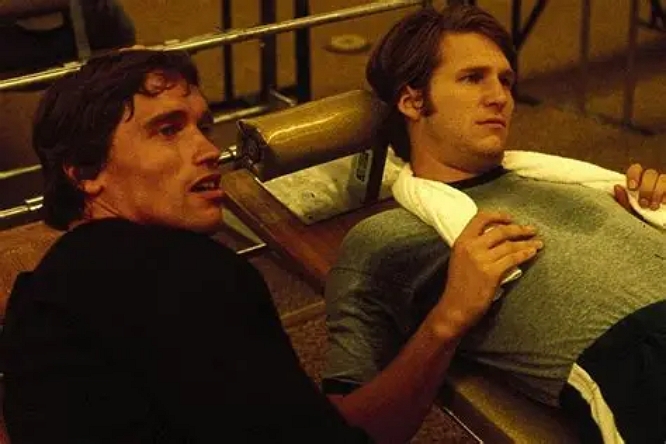
Meanwhile, things weren’t going quite so well for the Austrian man‑mountain. Arnie was still struggling to get a foothold in Hollywood. His third acting role, Stay Hungry, made a bit of a wave, not a tsunami, but at least a slight splash. He played Joe Santo, a fictionalised version of himself training for the Mr. Universe competition. More importantly, he got to rub shoulders with actual Hollywood talent: Jeff Bridges and Sally Field. It wasn’t Rocky, but it was something.
And then came the Golden Globes. Stay Hungry didn’t exactly sweep the awards, but Arnie did win something: the Golden Globe for Best Acting Debut in a Motion Picture (now called New Star of the Year). Never mind that Stay Hungry wasn’t actually his acting debut, Hollywood has always been flexible with definitions when it suits them. Do you know who else was at the Golden Globes that year? Sitting at the same table? Watching Rocky lose award after award? Sylvester Stallone.
The Golden Globes are often seen as the pre‑Oscars, a kind of warm‑up round that hints at how things might go at the big show. Rocky was up for seven awards and lost most of them. And according to Sly, Arnie laughed every time Rocky lost out to another film. Now, imagine being Stallone: you’ve poured your soul into this film, you’ve fought tooth and nail to get it made, you’ve turned down big money just to star in it, you sold your dog to raise money (Sly did buy him back), and you’re sitting next to a bloke holding a Golden Globe for Best Acting Debut in a Motion Picture award for a film that wasn’t even his debut… and he’s laughing at your losses. I can see how that would be a tad annoying. Sly eventually snapped and threw a bowl of flowers at Arnie. Not exactly the most “manly” of threats between two big muscle‑men, it’s not quite John Rambo vs The Terminator, it’s more like The Slightly Annoying Floral Assault of 1977. But it was enough. That moment was the genesis of the rivalry.
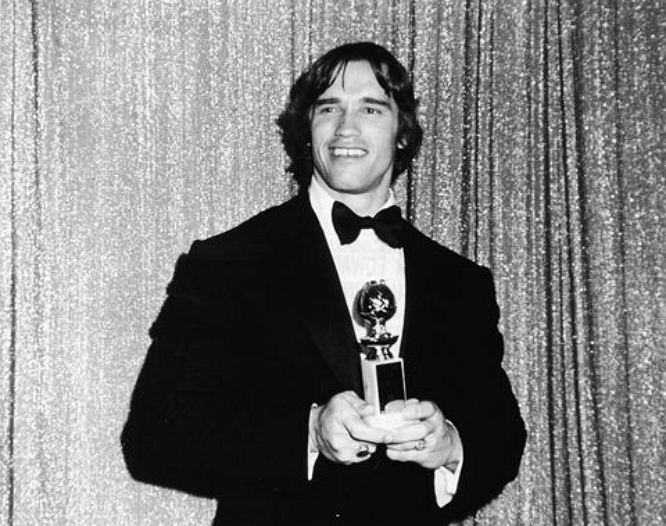
And honestly? As petty as Sly’s flower‑throwing was, I think I have to award him round two. He had the better film, the bigger cultural moment, and the industry‑shaking breakthrough. Rocky was a mighty lightning bolt. Stay Hungry was… someone flicking on a light switch, and quickly flicking it off again.
Not even big Hollywood flicks could keep up with the low-budget Rocky. Round two goes to Sly.
Round Three
So between the two of them, and by the late 1970s, Sylvester Stallone was unquestionably the bigger star. It wasn’t even close. Sly wasn’t just on Hollywood’s radar; he was on every global radar, the billboards, the magazine covers, the talk shows, the awards circuits. He’d gone from sleeping in a bus station to being the face of the biggest underdog story in cinema (much like the story of Rocky Balboa himself). Meanwhile, Arnie was still hovering around the edges of Hollywood like a very muscular shadow, waiting for the right role to finally let him kick the door down.
And here’s the thing: Sly’s success wasn’t just about acting. Rocky wasn’t a lucky break where he happened to be cast in the right film at the right time. It was his film. His script. His gamble. His sacrifice. He turned down massive offers. life‑changing amounts of money, just so he could star in it. He bet everything on himself, and it paid off in a way that almost never happens in Hollywood. To cover everything Sly sacrificed to get Rocky made would take a whole other article in itself. But the basics are this: Rocky wasn’t just a role for him. It was his identity. His shot. His proof that he belonged in the industry. And when it hit big, it didn’t just open a door, it blew the hinges clean off. That success gave Sly the freedom to evolve. He wasn’t content with being “just an actor”. He wanted to write. He wanted to direct. He wanted to shape his own career rather than wait for someone else to hand him opportunities. And he did exactly that.
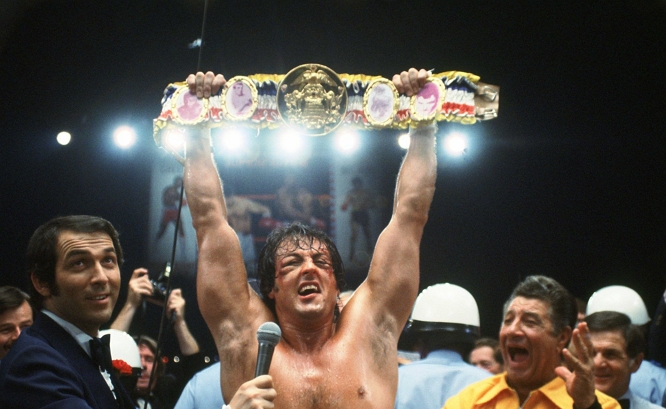
In 1978, Stallone made his directorial debut with Paradise Alley. It wasn’t a smash hit, but it showed ambition, the kind of ambition that says, “I’m not here to be a one‑film wonder.” And then came the big one: Rocky II in 1979. Written by Sly. Directed by Sly. Starring Sly. And it was another knockout hit. Not just a sequel, but a statement: he wasn’t going anywhere.
While Sly was becoming a multi‑hyphenate powerhouse, Arnie was still trying to find his footing. He followed up his Golden Globe win with Pumping Iron, the documentary about the 1975 Mr. Universe and Mr. Olympia competitions. It’s a great watch, part documentary, part performance art, part psychological warfare, part Arnie telling us how much he likes to cum, and it helped shape his public persona. But it wasn’t the kind of role that made him a movie star. It made him a curiosity. A notable interest. A presence. A “maybe one day” guy.
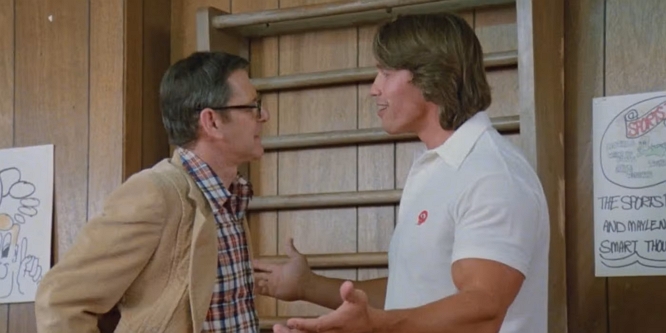
By 1979, when Sly was dominating the box office and expanding his creative empire, Arnie was appearing in Scavenger Hunt, a comedy with an impressive ensemble cast… in which he had a small role that wasn’t going to win him any more Golden Globes. It wasn’t a bad gig, but it wasn’t the breakout he needed either. Still, the ’70s ending and the ’80s beginning would change everything. Arnie was about to find his lane, and once he did, he’d become unstoppable. But at this point in the story? At this point, Sly was the one scaling the mountain while Arnie was at base camp, still looking for his crampons.
And that’s why round three is an easy call. Sly wasn’t just acting. He was writing, directing, and building franchises. Taking control of his career in a way that very few actors ever manage to pull off. He was pushing himself, expanding his skill set, and proving he wasn’t a one‑hit wonder. Arnie would get his moment, a massive one, but just not yet.
Sly takes the third round without breaking into a sweat.
Round Four
It was the 1980s when both Arnold Schwarzenegger and Sylvester Stallone stopped being “actors trying to make it” and became forces of nature. This was the decade of excess, bigger muscles, bigger explosions, bigger budgets, bigger egos, and these two were right at the centre of it, shaping the entire action genre like a pair of celluloid Greek gods.

Sly entered the decade already riding high. He had Rocky. He had Rocky II. He had the kind of momentum most actors would sacrifice a limb for. And he wasn’t slowing down. The ’80s saw him pump out hit after hit: more Rocky sequels, the birth of the Rambo franchise with First Blood in 1982, and a steady stream of action flicks like Cobra, Lock Up, Tango & Cash, and even Escape to Victory (World Cup year this year, I always watch it). He was everywhere, writing, directing, starring, and occasionally singing (we still don’t like to talk about Rhinestone). Sly wasn’t just an action star; he was a one‑man industry. But you could argue he was spreading himself a bit thin. When you’re juggling drama, action, comedy, musicals, and franchise management all at once, something’s bound to wobble.
Meanwhile, Arnie was about to land the role that would change everything. In 1982, Conan the Barbarian hit cinemas, and suddenly Hollywood realised what to do with this Austrian mountain of a muscle. Conan wasn’t just a film, it was a statement. Arnie wasn’t here to play second fiddle. He was here to dominate. The sequel, Conan the Destroyer, kept the momentum going, and the spin‑off Red Sonja (set in the same Hyborian Age) added to the growing mythos. But the real breakthrough, the moment Arnie went from “that big guy from the bodybuilding world” to “cinema icon”, came in 1984 with The Terminator.

Even now, The Terminator is one of the greatest sci‑fi films ever made. It’s lean, mean, relentless, and Arnie’s performance as the T‑800 is pure cinematic terror. He barely speaks, but he doesn’t need to. He’s a walking nightmare, a machine with a mission, and it cemented him as a global superstar. The franchise would eventually become his Rocky, and it would even go on to win Oscars. From there, Arnie’s ’80s run is just ridiculously awesome: Commando, Predator, The Running Man, Twins. Fewer films than Sly, but almost all of them stone-cold classics. And seeing Arnie do comedy in Twins was a revelation, the man is genuinely funny. He could be terrifying one minute and charming the next. He had range. And audiences loved him for it.
And all through all of this, the rivalry between the two wasn’t just simmering, it was boiling over. Arnie summed it up perfectly in a 2014 interview with The Economic Times:
Arnold Schwarzenegger: “We hated each other in the ’80s because we were both in the same business, we wanted to outdo each other. It was all‑out war. It was a competition of who has the most muscles, who kills the most people on screen, who kills in the most unique way, who makes more money at the box office.”
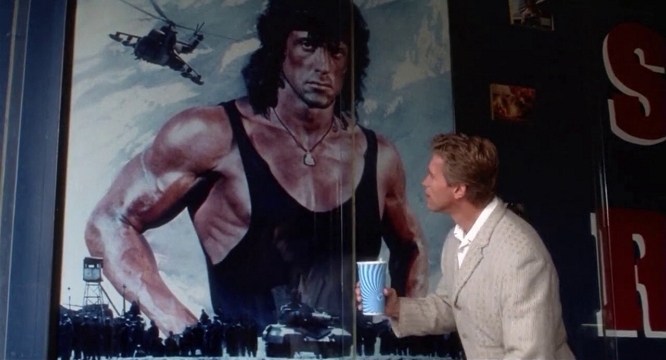
And it wasn’t just off screen. They were taking shots at each other everywhere, including in their films. In Twins, Arnie’s character makes a joke about Sly’s muscles when he sees a Rambo III poster. Sly fired back in Tango & Cash, beating up a henchman who looked suspiciously like Arnie. The press loved it. The studios loved it. The fans loved it more. And the two men absolutely leaned into it. Some have even suggested that Ivan Drago in Rocky IV, the towering, blond, accented, monosyllabic villain, was Sly’s parody of Arnie. A way to “beat up” his rival on screen. Whether that’s true or not, it certainly added fuel to the fire.
In 1985, Sly was the bigger star thanks to the Rocky and Rambo franchises. He was making the bigger movies, earning the most money, and his pictures were topping the box office. Arnie, not to be outdone, took a swipe at him in an interview with The News of the World (a newspaper that was, and remains, absolute arse-wiping toilet paper). He suggested that Sly used body doubles and said he was angry when his name was mentioned in the same sentence as Stallone’s.

Then things got really nasty. In February 1988, The News of the World ran a story claiming Arnie was a Nazi sympathiser, anti‑Semitic, and admired Hitler. It also claimed his father, Gustav Schwarzenegger, rounded up Jews during World War II, sent them to concentration camps, and was guilty of war crimes. The headline? “Hollywood Star’s Nazi Secret.” It was vile. It was defamatory. And many believed the source behind the story was none other than Sylvester Stallone. Arnie sued the paper in 1989 and won. Wendy Leigh, the “journalist” behind the article, later claimed Sly was the source, though this has never been confirmed. What is true is that Arnie’s father was part of the Austrian National Socialist Party, but there is zero evidence that he committed any war crimes. Arnie has always denounced any connection to Nazism and often speaks out against anti‑Semitism. Still, the damage was done. The rivalry had gone from petty flower-throwing to poisonous press involvement.
And then there was Brigitte Nielsen. Sly married her in 1985 after they filmed Rocky IV and Cobra together. But she’d also starred with Arnie in Red Sonja that same year, rumours swirled that she and Arnie had a “thing” during filming, and while Arnold was in a relationship with Maria Shriver. Add to that a story of Sly walking into a nightclub, seeing a picture of Arnie on the wall, demanding it be taken down, and having it destroyed… and you’ve got a rivalry that was starting to look like a soap opera with machine guns.
So who wins this round? It’s tough. Sly dominated the box office with the Rocky and Rambo franchises. He was writing, directing, acting, doing everything. A massive undertaking and impressive achievement. But I feel that he was also spreading himself too thin. Arnie, meanwhile, was doing fewer films but delivering hit after hit. Commando alone is basically the distilled essence of ’80s action cinema. And, crucially, Arnie didn’t write and star in Rhinestone.
So, by the tiniest of margins, I think Arnold wins this round.
Round Five
Before diving back into the films, I need to bring up that “journalist” from The News of the World one more time, Wendy Leigh. Because if the ’80s were the decade of muscle‑measuring and box‑office warfare, the early ’90s were the decade where the rivalry got… weird. Petty, personal, and occasionally downright Shakespearean, if Will Shakespeare had written about rocket launchers and protein shakes. Wendy Leigh published an unofficial Arnie biography in 1990 called Arnold: An Unauthorised Biography of Arnold Schwarzenegger. In it, she went into more detail about his early life and his “Nazi family”. Some have claimed (again, never confirmed) that some of the information used in this book came from Sly. Whether that’s true or not, it added another layer of tension to a rivalry that had already gone from playful jabs to tabloid‑fuelled nastiness.
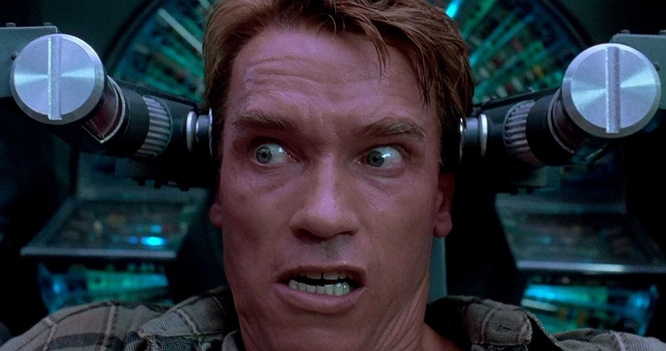
But let’s get to those films, because the ’90s were a rollercoaster for both men. Sly kicked off the decade by returning to the role that made him famous with Rocky V. It’s a film he dislikes, but one that I’ve always defended and will continue to defend. It’s not perfect, but it has heart, and it tried to take Rocky back to his roots. Meanwhile, Arnie began the ’90s with Total Recall, a massive, Paul Verhoeven, violent, sci‑fi fever dream that was a huge hit and showed that Arnold wasn’t slowing down. And then 1991 happened…
Sly released Oscar, a remake of a French comedy. The French original is pretty good. The remake is… not as good and was a massive flop. A film so tonally confused it feels like it was written by someone who’d never seen a comedy but had read a small article about them once in a several years old magazine in a barber shop. Arnie, on the other hand, was in Terminator 2: Judgment Day, often considered as one of the greatest sequels ever made. Some people even rate it higher than the original. Not me, I still prefer The Terminator, but there’s no denying that T2 was gargantuan. A cultural earthquake. The kind of film that defines a decade, or several decades. With Total Recall and T2 in the bag, the early ’90s belonged to Arnie, no question.
Arnie didn’t release any films in 1992, not that he needed to after T2. But he could have had a film out that year if he hadn’t been so brilliantly sneaky and manipulative. Because Sly did have a film in 1992: the truly awful Stop! Or My Mom Will Shoot. And the story of how Sly ended up in that cinematic disaster is one of my favourite Hollywood tales ever. The rivalry between Arnie and Sly was still running hot as the ’80s ended and the ’90s began. Both were hunting for the next big box‑office hit. Arnie got hold of the script for Stop! Or My Mom Will Shoot, read it, and immediately realised it was terrible. Not just bad, really, really bad. The kind of bad that makes you question whether the writer had lost a bet.
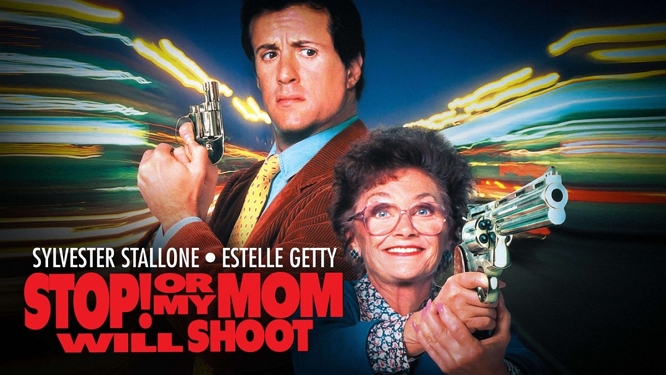
So Arnie did what any self‑respecting action star locked in a petty rivalry would do: he weaponised the script. As Arnie himself said in a SlashFilm interview from 2017:
Arnold Schwarzenegger: “I read the script. It was so bad… So I went in, this was during our war, I said to myself, I’m going to leak out that I have tremendous interest. I know the way it works in Hollywood. I would then ask for a lot of money. So then they’d say, ‘Let’s go give it to Sly. Maybe we can get him for cheaper.’ So they told Sly, ‘Schwarzenegger’s interested… If you want to grab that one away from him, that is available.’ And he went for it! A week later, I heard, ‘Sly is signing now.’ And I said, [pumps fist] ‘Yes!’”
Even Sly backed this story up on The Tonight Show in 2014:
Sylvester Stallone: “We were very competitive, I think ‘hate’ is a good word… My agent said, ‘I’m telling you, if you don’t do Stop! Or My Mom Will Shoot, he’s in.’”
I can imagine it right now, Arnie sitting there with a fat stogie, laughing his balls off as Sly unknowingly walks into a cinematic bear trap. And the film even includes a jab: Estelle Getty’s character says “I’ll be back,” and Sly’s character replies, “Terminators say that, not cops.” A jab that is ironically even funnier when you compare the masterpiece that is The Terminator to Stop! Or My Mom Will Shoot.
These little digs continued through the ’90s, but the tone had shifted. The bitterness of the late ’70s and ’80s had softened. The rivalry was no longer venomous; it was more like two brothers constantly trying to one‑up each other. Still competitive, still petty, but with a wink instead of a snarl. And a big part of that shift was Planet Hollywood. Along with Bruce Willis, Arnie and Sly became investors and the public faces of the Planet Hollywood restaurant chain. Instead of trying to destroy each other, they were suddenly business partners. The rivalry didn’t die, it just evolved into something more playful, more performative, more fun.
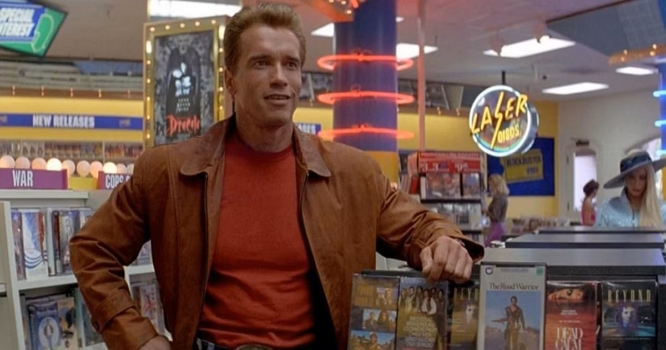
Both men had some great films in the ’90s. Arnie had Last Action Hero, destroyed by critics at the time, but I love it. Again, a film that shows Arnie had a great sense of humour and that he was not afraid to make fun of himself. It also features one of my favourite fun digs with Sly starring in T2 in the film’s fictional universe. Arnie also had True Lies, an amazing flick. Sly had Cliffhanger, Demolition Man (with the “President Schwarzenegger Library” gag), and the vastly overlooked Assassins. And, for me, his best performance since the original Rocky: Sheriff Freddy Heflin in Cop Land. What a film! What a performance! Proof that Sly wasn’t just an action star, he was an actor, and a damn good one.
So who wins this round? The ’90s were a mixed bag for both. Arnie had the biggest hit of the decade with T2. He had the box‑office dominance. He stomped a massive cultural footprint… and he pulled off one of the greatest pranks in Hollywood history by tricking Sly into doing Stop! Or My Mom Will Shoot. But Sly had the better overall films (not counting the flops). Maybe not the biggest, but I would argue that they were better made. And Cop Land alone is almost enough to tip the scales. Still… the sheer magnitude of T2 is impossible to ignore.
Round five goes to Arnie, but only by the tiniest of a hair.
Round Six
By the time the calendar flipped into the 2000s, the rivalry between Arnold Schwarzenegger and Sylvester Stallone had already gone through more phases than a long‑running Mexican soap opera. They’d been enemies, competitors, pranksters, business partners, and brotherly jab takers. But the new millennium brought something neither of them had really dealt with before: age, reinvention, and a Hollywood that suddenly wasn’t sure what to do with the old‑school action hero anymore.
Without a doubt, Sly had the larger filmography in the early 2000s, but only because Arnie had wandered off to become the Governor of California. You can’t exactly shoot a jungle‑exploding action flick, while spouting witty one-liners when you’re busy signing state budgets and shaking hands with Californian vintners. So Arnie’s Hollywood career went on ice from 2003 to 2011, leaving Sly with a clear runway to reclaim some box‑office territory. But there was a problem? Sly’s early‑2000s output wasn’t exactly inspiring. Get Carter (the remake) was… well, shit. Most of his films from that era were forgettable, the kind of movies you find in a bargain bin at a petrol station and still decide not to buy. Honestly, he probably would’ve been better off taking a sabbatical like Arnie did, minus the whole “running the world’s fifth‑largest economy” part.
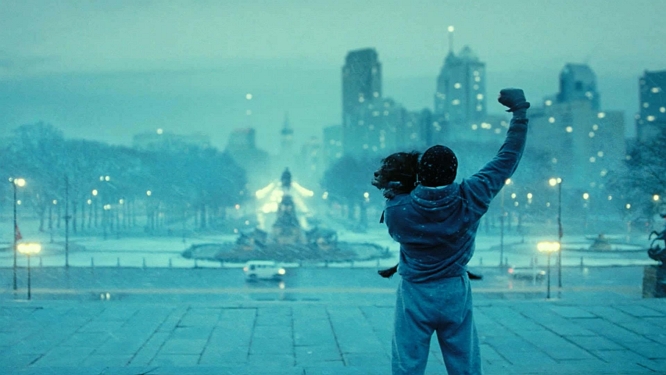
And then 2006 happened. Sly came back swinging with Rocky Balboa, and it wasn’t just a comeback; it was a resurrection. A film that felt like a love letter to the character, the fans, and even to Sly himself. It was an allegory for his own career: written off, down for the count, dismissed as past it… only to step back into the ring and remind everyone exactly who the hell he was. I remember watching Rocky Balboa, expecting a cheesy trainwreck. Instead, the end credits rolled, and I had a lump in my throat, a tear in my eye, and the realisation that I’d genuinely and honestly missed him, both Sly and Rocky. It was a beautiful, heartfelt film that not only proved that Stallone still had something to say, but that people wanted to listen.
Then, two years later, he doubled down with Rambo (2008). Now, I adore First Blood. The next two films are fine, fun, loud, very ’80s, but Rambo (2008) was something else entirely. Brutal, raw, angry. A film that felt like Sly was sticking two middle fingers up at Hollywood and saying, “I’m still here, and I’m still fucking awesome!” Even the author of First Blood, praised it:
David Morrell: “The level of violence might not be for everyone, but it has a serious intent… It’s spot‑on in terms of how I imagined the character, angry, burned‑out, and filled with self‑disgust.”
When the creator of the character says that someone else nailed the intent of that character, you know you’ve done well as a writer and director. This was Sly’s powerful one‑two punch: Rocky Balboa and Rambo. Two characters that made Sly a household name, both resurrected with surprising depth and power. And both movies were written and directed by him. It was the comeback of comebacks… and I adored it.

By the time the 2010s rolled around, Sly was riding high again, and he made something happen that fans had wanted since the 1980s: he and Arnie finally shared the big screen in The Expendables. It was like The Avengers for ’80s action‑movie fans. Sly writing, directing, and starring. Arnie popping in for a cheeky cameo (still busy governing California at the time). Bruce Willis joining the party. It was the holy trinity of ’80s action icons in one room. As the sequels rolled out, Arnie’s roles grew bigger, and the two of them finally got a proper co‑lead outing in Escape Plan, which felt like a cinematic handshake after decades of rivalry.
Arnie, for his part, returned to acting with a mix of hits, misses, and interesting experiments. Terminator Genisys was a mess, but Arnie himself was great in it. And then came Maggie and Aftermath, two surprising, dramatic roles that showed he could do far more than fire an Uzi 9mm and say “I’ll be back”. Seeing him take on quiet, emotional characters was genuinely refreshing. And then there’s Killing Gunther, a mockumentary action comedy where Arnie is in full, glorious, over‑the‑top form. It’s silly, chaotic, and an absolute joy.
In 2023, both men had documentaries released about their lives and careers: Arnold (a three‑part series) and Sly (a feature documentary). Both are well worth watching if you want a deeper look into the minds of two men who shaped modern action cinema.
And here’s the thing: Sly’s comeback wasn’t just good, it was glorious. He went from being considered washed up to delivering some of the best work of his career (that Rocky Balboa speech is *chef’s kiss*). He brought back Rocky. He brought back Rambo. He built The Expendables. He reunited the titans. He reminded the world why he still mattered. Arnie had some great flicks too, but I can’t help wondering: if he hadn’t become Governor, would we have seen more, and better, films from him during that period? Would he have had his own “Rocky Balboa moment”? Hard to say.
Sly dominates this round. It’s not even close.
Final Score
So then, after all the decades, all the flexing, all the explosions, all the one‑liners, all the petty digs, all the tabloid nonsense, all the box‑office battles, all the comebacks, all the reinventions, who actually won the rivalry between Arnold Schwarzenegger and Sylvester Stallone? Well… according to my scorecard, they each take three rounds. A dead heat. A draw. A split decision. The kind of ending that would get booed at a big Vegas boxing match (or a Jake Paul scripted one) but somehow feels absolutely perfect here in this article.

But the truth is, those round wins don’t tell the whole story. Because this rivalry wasn’t just about who had the bigger biceps, or who had the bigger box‑office hit, or who killed more bad guys with more creative weaponry. It wasn’t even really about who was “better”. It was about two men pushing each other, sometimes out of spite, sometimes out of hate, sometimes out of insecurity, sometimes out of pure competitive fire, to become the cinema icons they eventually became. And honestly? We, the audience, won a lot of this rivalry. We got Rocky. We got The Terminator. We got Predator, Rambo, Commando, Demolition Man, True Lies, Cliffhanger, The Running Man, Cop Land, Twins, The Expendables, and about a hundred other films that defined entire eras of cinema. We got the posters, the VHS tapes, the DVDs, the catchphrases, the action figures, the parodies, the memories. We got two careers that shaped pop culture forever.
But there’s one question worth asking, one that only really becomes important when you look at the whole story from the late ’60s to today. If their rivalry hadn’t been so bitter in the ’80s, if Arnie and Sly hadn’t been so determined to outdo each other, would we have seen them share the screen sooner? Would we have had a proper Arnie and Sly buddy‑cop film in 1987? A two‑hander action epic in 1989? A crossover between Rambo and The Terminator before the idea of cinematic universes was even a thing? Maybe. Maybe not. But it’s hard not to feel like we missed out on something special.
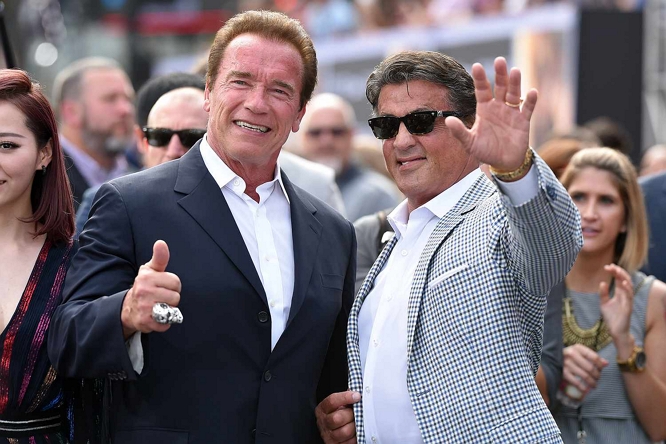
Still, you can’t live in the land of “what if”. You take the films you got, not the ones you imagine. And what we got was pretty damn good. But here’s the real twist. The real ending. The real KO punch to this decades‑long saga. The true winners of this rivalry weren’t the studios, or the fans, or the critics, or the box‑office charts. The real winners were Arnie and Sly themselves. Not because of the money, or the fame, or the franchises, or the awards. But because, after everything, after the flower‑throwing, the insults, the rumours, the sabotage, the tabloids, the competition, the bitterness, the two men ended up as close, genuine friends. And that’s not Hollywood PR fluff, that’s real.
In 2006, Arnie had a skiing accident that left him needing surgery. He was in hospital, in pain, feeling low. And who walked in to visit him? Sly. Not as a rival. Not as a co‑star. Not as a business partner. As a friend. He brought Arnie a pair of boxing gloves, a symbolic reminder to keep fighting. That wouldn’t have happened in 1986. But it did happen three decades later, and when it mattered. Two men who once hated each other ended up respecting each other. Admiring each other. Supporting each other. And, in the end, becoming something like brothers, forged not by blood, but by decades of shared battles, shared struggles, shared triumphs, and shared history.
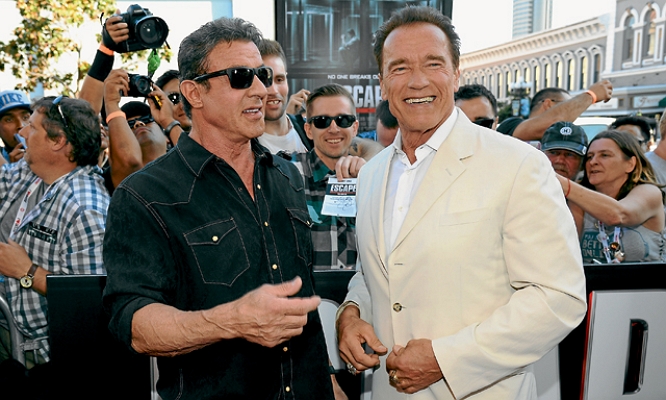
So who won? Arnie won. Sly won. The fans won. But the biggest win, the one that actually matters, is that after all the smoke cleared, after all the egos settled, after all the years passed… two action‑movie legends found a genuine friendship. And that’s as great an ending as you could wish for and the kind of Hollywood biopic I’d love to see get made.


Please leave a reply/comment.