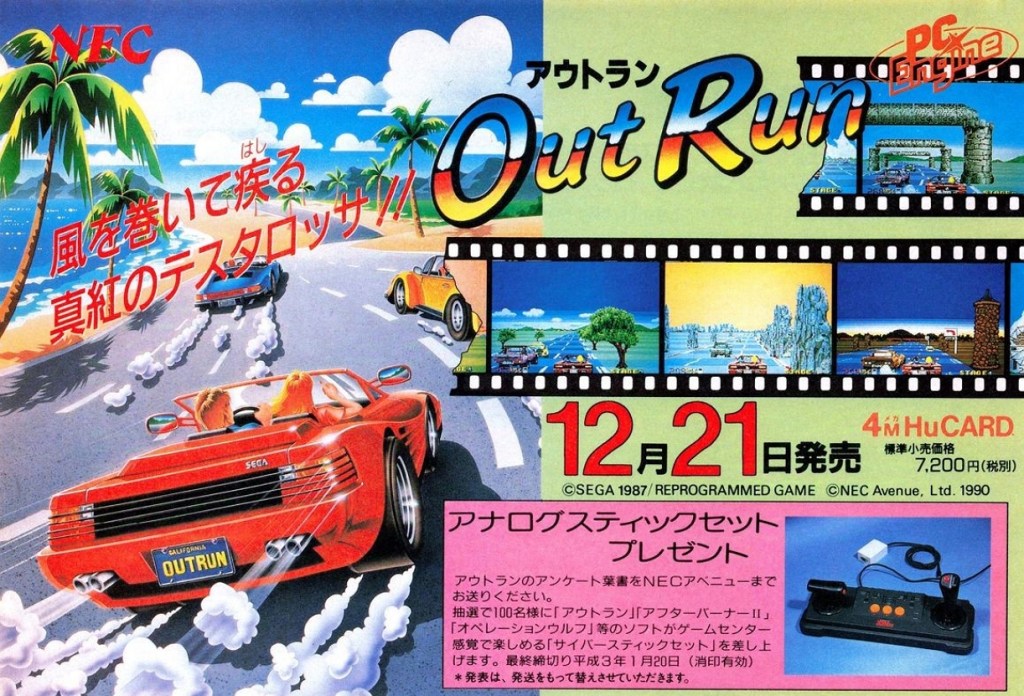
Well, I just about survived playing some of the worst Out Run ports ever inflicted on home computers in part one. Now it’s time to carve my way through the console versions, and hopefully, this time, some of them are actually playable… hopefully.
TurboGrafx-16
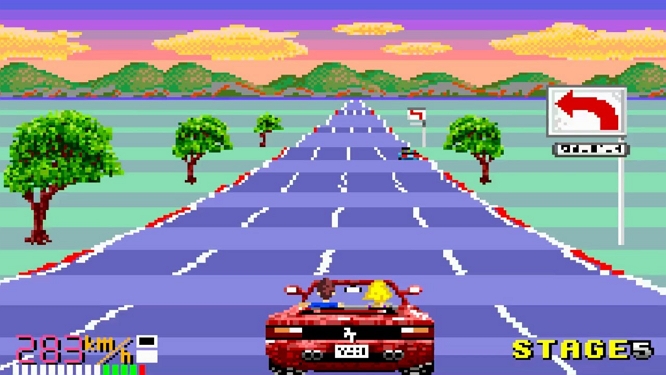
To kick off the console ports, I’m starting in that weird limbo between 8‑bit and 16‑bit: the TurboGrafx‑16, or PC Engine if you’re feeling Japanese and fancy. On paper, it’s got an 8‑bit CPU, but the dual 16‑bit graphics processors mean it punches well above its weight. It is a fourth‑gen, 16‑bit console, the “16” in the name isn’t just marketing bravado, even if some people still insist on calling it an 8‑bit machine. I bring this up because it explains why this port of Out Run looks so damn good.
It’s not arcade perfect, and if you know the original well you’ll spot the missing flourishes. But honestly? This is still a damn fine‑looking version of Out Run. It’s fast, it’s smooth, and it plays really well. Of all the home ports so far, this is the standout. The only real negative is the audio. The music and sound effects are… well, they’re there. Not terrible, and I’ve heard far worse with some of the computer ports, but definitely a weak point of this conversion.
Master System
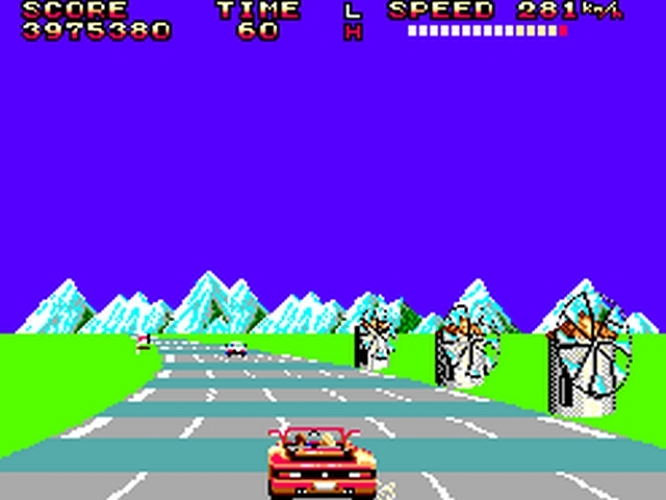
With Out Run being a Sega game and the Master System being a Sega console, you’d expect this to be one of the best home versions. And honestly? It’s pretty good, but the 8‑bit hardware is clearly straining at the seams. This port feels very reminiscent of the MSX2 and DOS versions, and I’d hazard a guess they all share the same codebase. Much like the MSX2 version, this Master System outing also lacks dense traffic, and it’s not as smooth or as fast as the DOS port. Even so, for an 8‑bit machine, this is a respectable effort.
Side note. There were actually two versions of Out Run on the Master System: the standard one above, and Out Run 3D. This required the Master System’s stereoscopic 3D glasses, a peripheral that was both ahead of its time and stupidly expensive. Only a handful of games supported them, and Out Run was one of the lucky few.
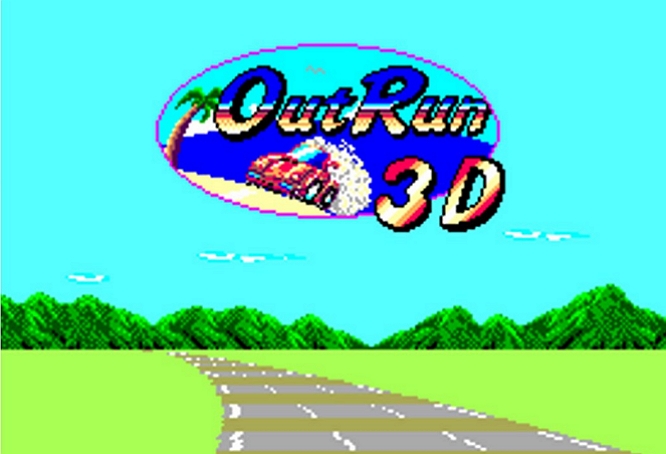
Gameplay was largely the same (with a couple of new bells and whistles), but the frame rate took a nosedive. Because the 3D glasses rapidly alternated between left‑eye and right‑eye images, the effective frame rate was almost cut in half, making the game stutter like a drunk actor trying to recite Shakespeare. This version had some nice new features, but the original non‑3D version simply plays better, and the glasses didn’t add much beyond the novelty of saying, “Look, it’s (not very good) 3D!”
Mega Drive
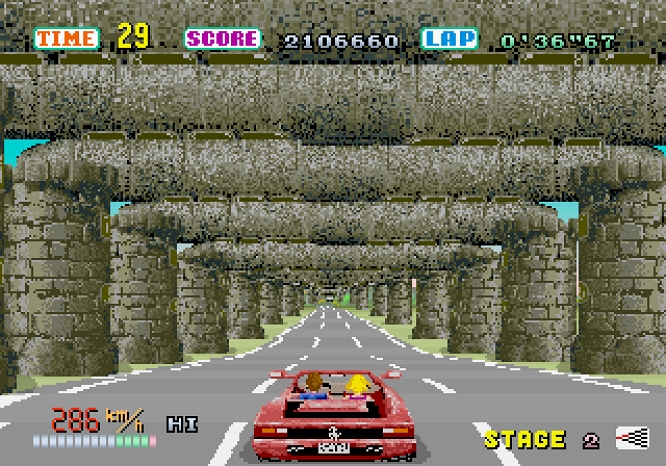
Now let’s see what the Master System’s bigger, moodier brother can do. This Mega Drive port was about as close to arcade perfect as you could reasonably get at the time. It’s not a carbon copy, but it’s damn close: fast, smooth, feature‑complete, and unmistakably Out Run. The graphics look great, and there’s no universe in which someone could mistake this for anything else. If I had to nitpick, it’d be the music. It’s good, it’s recognisable, but it’s just off enough that you notice. The Mega Drive’s sound hardware was famously divisive, sometimes capable of brilliance, but also capable of sounding like a robot gargling gravel.
One fun detail: in the arcade original, to save memory, Sega simply flipped the car sprite when you turned, which meant the Ferrari badge on the back also flipped, a tiny but infamous quirk. Most home ports copied this shortcut… but not the Mega Drive version. No badge flipping here. Someone at Sega clearly decided, “No, we’re doing this properly”.
Game Gear
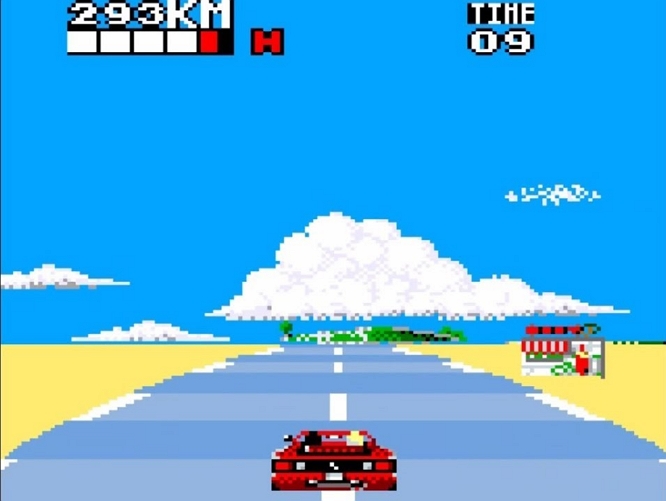
The Game Gear version immediately gave me déjà vu, it’s basically the MSX2 port wearing a slightly nicer jacket, with a dash of the DOS version thrown in for seasoning. Considering the Game Gear was essentially a handheld Master System with a severe battery addiction, you’d expect this port to be a straight lift of the Master System version. But no. Somehow it’s different, and not in a “pleasant surprise” way. It’s playable, just about, and for a handheld of the early ’90s, it’s not a total disaster. But it really should’ve been an upgrade of the Master System port, not a sideways shuffle into mediocrity.
Saturn
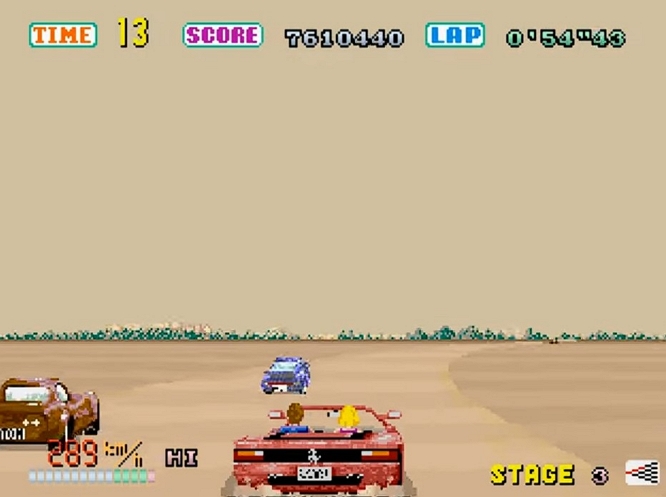
Now this is where things get exciting. The Saturn should, in theory, deliver the best Out Run port ever created. It’s more powerful than the original arcade hardware, so there are zero excuses for anything less than perfection. And honestly? It delivers.
Released a spart of the SEGA AGES collection, this port is so arcade perfect that the infamous flipping Ferrari badge is back in all its glory. In fact, you could argue this version goes beyond arcade perfect. The Saturn edition includes remixed music that enhances the originals without butchering them, and… brace yourself… it runs at 60 fps. Even the arcade machine only managed 30. Nowadays, people love to pretend frame rate doesn’t really matter, but in a blisteringly fast arcade racer like Out Run, it absolutely does. This Saturn port is buttery smooth.
Game Boy Advance
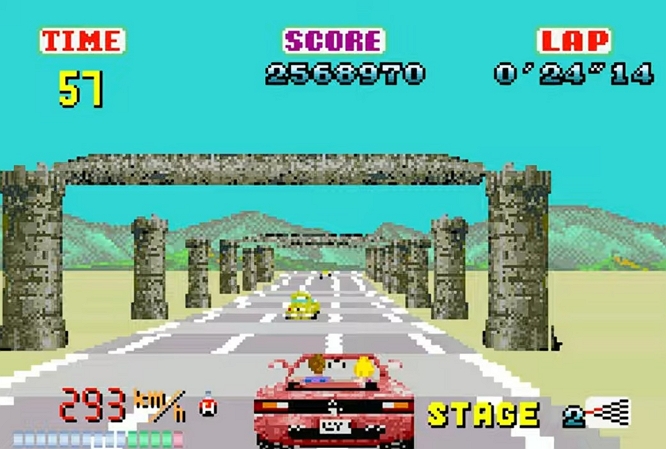
WHAT! A Sega game on a Nintendo machine, and not just any Sega game, an iconic Sega game. What heresy is this? Back in the 80s and 90s, Sega releasing games on their biggest rival’s machines would never have happened. The scandal! The… oh right, Sega stopped making consoles after the Dreamcast and were more than happy to put Sonic on anything with a screen. Even Mario hangs out with him now and then. But enough fake shock for comic effect.
The important bit: the GBA version (part of the Sega Arcade Gallery collection) is really bloody good. Not Saturn‑tier, but I’d put it on par with, maybe even slightly above, the Mega Drive version. Sure, some tiny details are missing and the resolution is lower, but it plays beautifully. For a handheld, this is seriously impressive stuff.
3DS
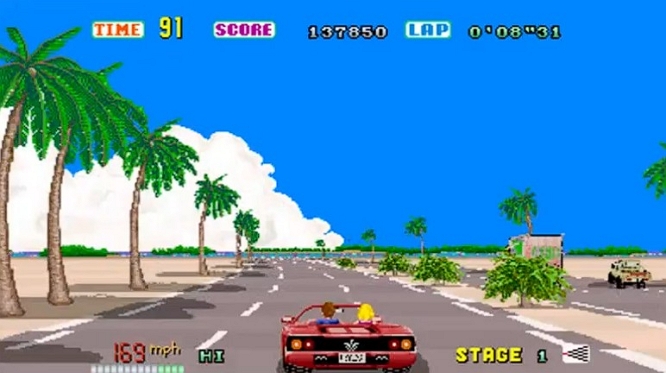
WHAT! A Sega game on a Nintendo machine, and not just any Sega game, an iconic Sega game. What heresy is this? Wait, I already did that bit. The 3DS version is brilliant for one simple reason: the 3D actually works. Unlike the Master System’s migraine‑inducing attempt at stereoscopy, the 3DS had the tech to pull it off properly. And this port doesn’t stop there. You got several modern updates. 60 fps as standard. Widescreen display. New music that slots right in with the classics. And a light upgrade system, finish a route, unlock a tune‑up, repeat for each of the five routes. I think this was the first version of Out Run to feature an upgrade system.
I also think this was the first Out Run port that had to change the car because Sega no longer had the Ferrari license, so they couldn’t use the iconic blood red Testarossa anymore. Instead, the car was swapped out with a generic Ferrari-looking red sports car, it’s looks fine though. Aside from that, this was one of those arcade-perfect ports. It was fast, smooth, and the 3D effect actually worked well. A great version.
Switch
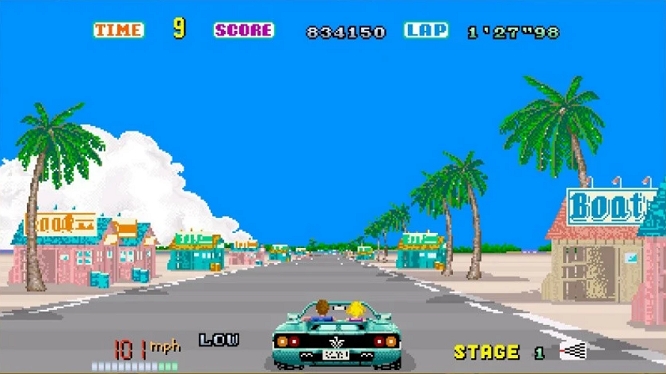
The Switch version arrived as part of the SEGA AGES line, a collection of classic Sega titles polished up with modern conveniences. This one builds directly on the 3DS port, minus the 3D effect, but it did add some new features. Motion controls. Online ranking. New tunes. Different car colours (when using the upgrades). Difficulty setting. Adjustable time limits. All the tune‑ups from the 3DS version
This is arguably the most customisable version of Out Run ever released. It keeps everything great about the 3DS port (except the 3D effect) and layers even more options on top. Definitely one of the best modern ports.
PlayStation 2
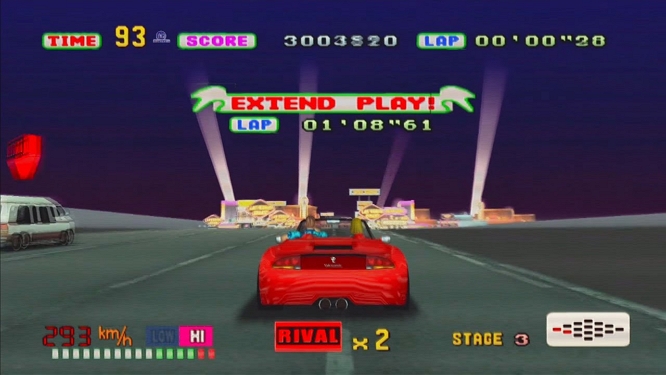
Up to now, I’ve mostly been dealing with ports, some good, some tragic. But the PS2 version? This isn’t a port at all. It’s a full remake, rebuilt from scratch in early‑2000s polygonal splendour as part of the Sega Classics Collection. And remember when I said the 3DS version was the first to change the car because of the Ferrari license? I was wrong. The PS2 remake beat it by over a decade. Sega lost the Ferrari license twice, renewed it in between to make some new Out Run games (I’ll get to those in the next article), and this remake landed during the “Ferrari‑free” era. Hence the… thing… they replaced the Testarossa with.
And I’ll be honest: the car is ugly. It’s boxy, it lacks the sleekness of the Testarossa, and it sits too high on the screen, blocking your view like a toddler standing in front of the telly. But that’s where my complaints end because the remake itself? It’s actually really good. You get multiple game modes, including rival races. Remade music that sounds fantastic. Tons of options (difficulty, time limits, handling tweaks, etc.). It’s a solid racer, a loving reinterpretation of the classic, and absolutely worth revisiting now and then, even if the arcade original still reigns supreme. The car may be ugly, but the rest of the graphics work, and this feels like the older brother of the arcade original.
Dreamcast
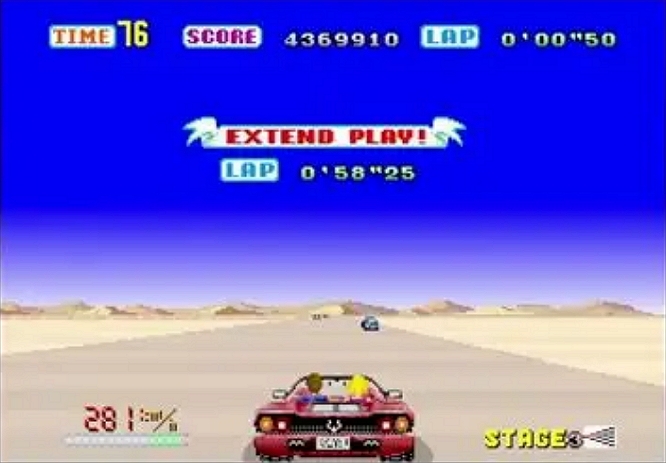
And we’re back to a Sega classic running on a Sega machine, the last Sega machine, in fact, before they bowed out of the hardware business. The Dreamcast gave you three ways to play Out Run, and all of them were the same slightly updated arcade port. The most famous appearances were in Shenmue and Shenmue II, where you could wander into an arcade and play Out Run exactly as Yu Suzuki intended (minus the Ferrari). Japan also got the Yu Suzuki Game Works Vol. 1 collection, which included Out Run as a standalone title. Whichever route you took, you got the same thing: higher‑resolution visuals, a legally distinct red sports car, and gameplay that felt just like the arcade original. It’s solid, smooth, and faithful, one of those ports where you can’t really go wrong.
Yakuza (various consoles)
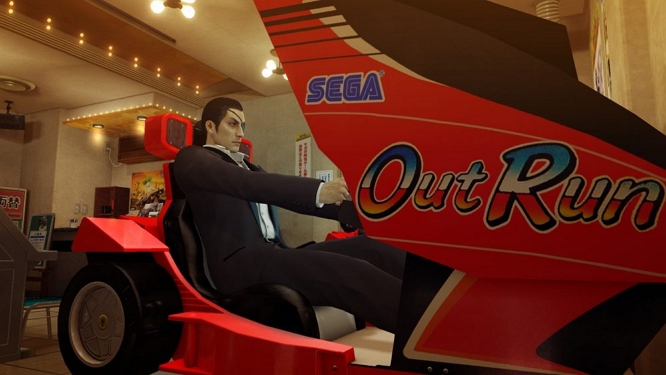
Right, now I think I’m at the end. These should be the final home versions of Out Run, the ones tucked away inside Sega’s modern crime‑drama‑soap‑opera‑brawler hybrid, Yakuza. Several entries, Yakuza 0, Yakuza 6, Yakuza: Like a Dragon, and the remastered Judgment, all feature playable Out Run cabinets As far as I can tell, these are the same ports used in the Dreamcast/Shenmue versions. I didn’t spot any differences, and if there are any, they’re microscopic. It’s the same faithful arcade‑style experience, just now surrounded by karaoke bars, hostess clubs, and men in suits punching each other through vending machines.
Tiger LCD
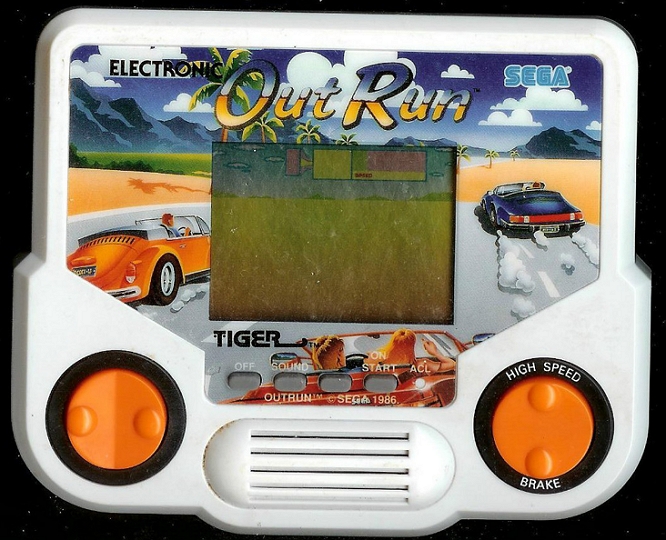
No… wait.. one more. The Tiger handheld. These things were awful. All of them. To this day, I still don’t understand why Tiger LCD games existed. Maybe some of the earlier ones were passable, but once they started trying to recreate arcade classics, the whole enterprise collapsed under the weight of its own ambition. Home ports struggled on 8‑bit hardware. Some even struggled on 16‑bit hardware. Tiger LCD games weren’t 16‑bit. They weren’t 8‑bit. They were… half-a-bit. Maybe. On a good day.
There was no universe in which one of these LCD toys could capture the “pleasure of driving” Yu Suzuki was aiming for. All you do is move left and right to dodge slow‑moving blobs pretending to be cars. That’s it. That’s the whole game. And that’s basically what every Tiger LCD game was: a massively stripped‑back husk that barely resembled the thing it was supposedly adapting. They even made a Street Fighter II Tiger LCD game, and that’s about as faithful to the original as a stick figure is to the Mona Lisa.
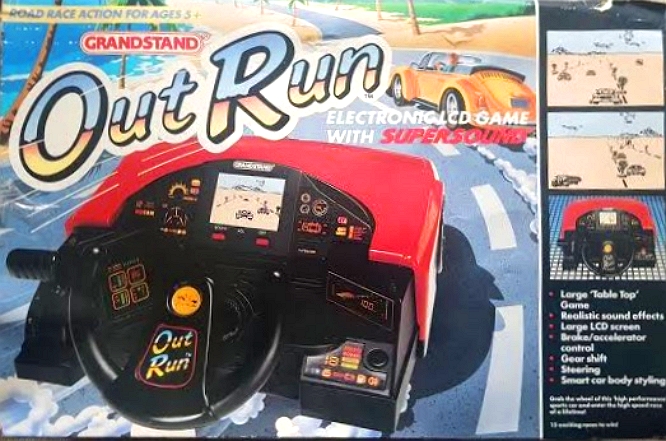
Even better (or worse), Out Run had two Tiger LCD versions: the handheld one and a “deluxe” tabletop model (see above) where the same tiny LCD screen was shoved into a miniature Ferrari shell. Same bad game, different plastic.
As with the Amiga fan‑made version I mentioned in part one, there have been other unofficial ports floating around, including a surprisingly decent Game Boy Color fan project. But for this retrospective, I just wanted to stick to the official releases.
And that’s it. Every (as far as I can tell) official home version of Out Run. From the sublime Saturn port to the half‑a‑bit Tiger tragedy, from Sega’s own hardware to Nintendo’s handhelds, from remakes to re‑releases to arcade cabinets hidden inside sprawling open‑world adventures. Out Run has had one hell of a journey, and I’ve not even covered the sequels and spin-offs… yet. See you in the next part of my 40 Years Of Out Run celebration.

 Little Bits of Gaming & Movies
Please leave a reply/comment.