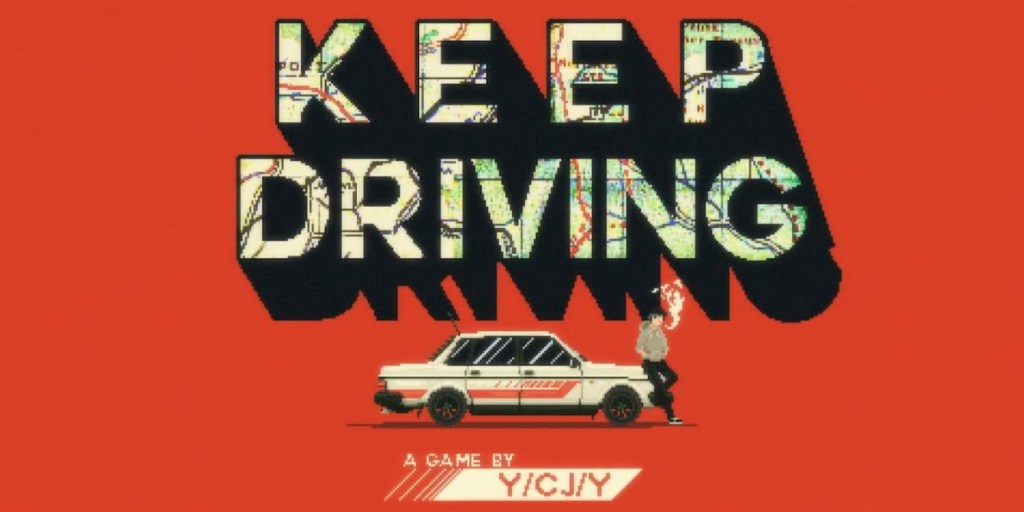
When is a driving game not a driving game? When YCJY Games and Kepler Ghost release Keep Driving, a game where driving sits at the very heart of the experience… yet you don’t actually do any driving.
“An atmospheric management RPG about life on the open road. Pick up hitchhikers, work odd jobs, customize and repair your car, and map your route across the country. Use upgrades, skills and items to overcome challenges. And remember to take it easy. You’re young. You have time.”
As the blurb says, Keep Driving is a management RPG. Perhaps the easiest way I can explain this one is by mentioning another game. Did you ever play any version of the all-time classic The Oregon Trail? Because that’s pretty much what Keep Driving is. Only with a much more modern angle, considerably more depth… and a lot less dying from dysentery.
The story is simple. It’s the early 2000s. You’re young, you’ve been invited to a music festival on the other side of the country and, with very little else seemingly tying you down, you jump into your car and hit the open road. You’ve got four in-game weeks to get there. Open the map, choose a route and away you go.
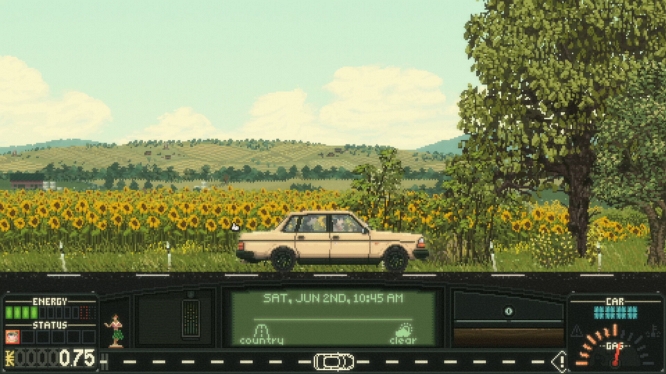
You can only move from one location on the map to another at a time, but as we are talking about a cross country, multi-road network here, this isn’t a simple journey from A to Z. While you travel from one location to another, the map is a sprawling network of towns, cities and roads, offering numerous potential routes across the country. You might go from A to B, then F, perhaps S, back towards B, stop off at C, head across to P, and only much later start thinking about heading to Z. There’s no prescribed route and no single “correct” way of making the journey. As long as you reach the festival in time, it’s all good. And that’s where Keep Driving begins to reveal what it’s really about.
Moving between locations triggers road events, and, speaking in RPG terms, these effectively become Keep Driving’s enemies. Despite the laid-back road-trip premise, the game underneath is a turn-based RPG. Only instead of fighting dragons, mutants, slimes, or heavily armed blokes with questionable motives, you might find yourself battling a flat tyre, or a bee flying around inside the car, potholes, traffic jams, biker gangs, bad weather, the police pulling you over… a cow! This game’s enemies, basically, is life on the road.
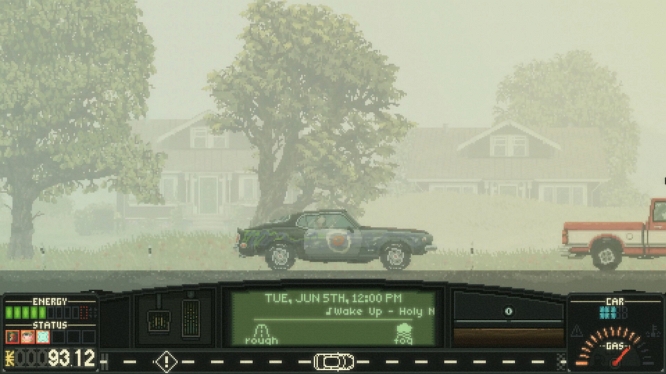
Each event threatens four colour-coded attributes. Energy (green) represents your tiredness. Durability (blue) represents the condition of your car. Fuel (orange) is, well, fuel. And finally there’s money (yellow), which requires even less explanation but rapidly proves to be every bit as important as the other three. During an encounter, threats appear against one or more of these resources and you use skill cards to counter them, gradually overcoming the event before it does too much damage. It’s a straightforward system to understand, but there’s considerably more strategy involved than there initially appears. You’re not simply trying to win an individual encounter. You have to consider what condition it will leave you in afterwards. Surviving something with barely any fuel, an exhausted driver and a car held together by optimism isn’t necessarily much of a victory when the next town is still miles away.
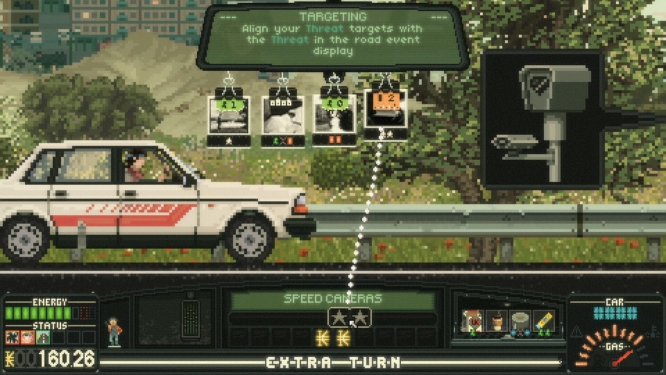
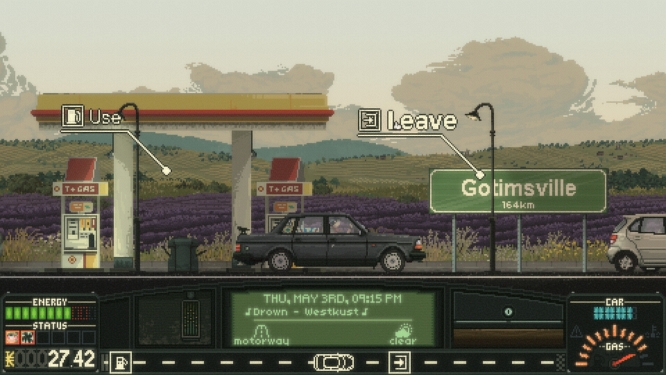
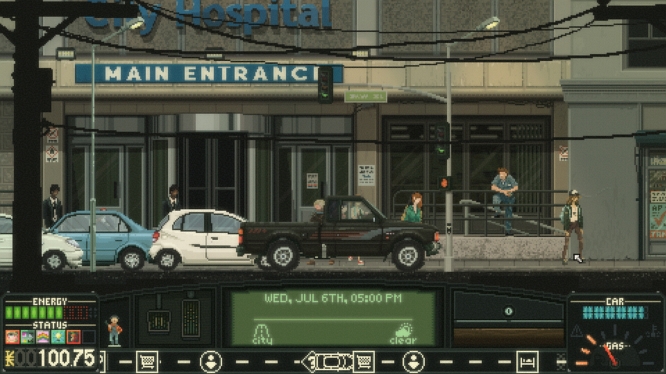
As you travel across the country, those four attributes constantly need attention, and different locations provide different ways of replenishing them. You can sleep in your car or find a hotel or hostel to recover energy. Garages repair your vehicle’s durability, although you can have a go yourself if you’ve got a toolbox. Petrol stations keep the tank filled, while a conveniently stocked jerry can can save you when you’re between stops. Money, meanwhile, is the lifeblood of the entire adventure. Without it, you’re not doing much of anything. Luckily, there are plenty of ways to earn some cash. You can sell unwanted items from your inventory, take jobs at the expense of energy or accept side missions. Perhaps you’ll deliver pizzas. Maybe you’ll plaster an advert across the side of the car and get paid simply for driving around. You might even end up looking for somebody’s missing cat.
There’s always something tempting you away from the most direct route, and that creates one of the game’s most effective little dilemmas. Do you concentrate on reaching your destination, or take a detour because there might be money, supplies, a useful upgrade or an interesting encounter waiting for you? It gives each journey a pleasing sense of improvisation. You have a destination. Everything between here and there is negotiable.
Depleting one (or more) of your four attributes isn’t necessarily game over either. Run out of energy? Sleep in your car, even if you’re stuck out on the road. Car wrecked? Call a tow truck and get taken back to the previous location, assuming you can afford it. No fuel? You might be able to walk to a petrol station, provided you’ve got enough energy and money to make that solution viable. And when things have gone completely pear-shaped, there’s always the ultimate humiliation…. call your parents. Mum and Dad might bail you out, but their patience isn’t unlimited. You may get away with calling once. Perhaps twice. Keep making a habit of it and the chances of them helping become increasingly slim.
Eventually, you can reach a situation where there’s simply nothing left to do. No fuel. No viable rescue. Not even your parents answering the phone. That’s game over. So you start another run.
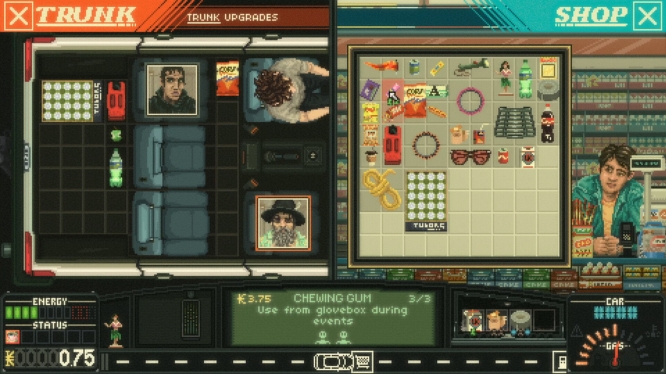
The various locations scattered across the map contain businesses where you can buy food and drink, repair the car, purchase upgrades or stock up on other useful supplies. Your boot doubles as your inventory, and space is limited, forcing you into another layer of resource management. That spare fuel might save your life later, but it’s also taking up space that could be used for food, tools or something you can sell further down the road.
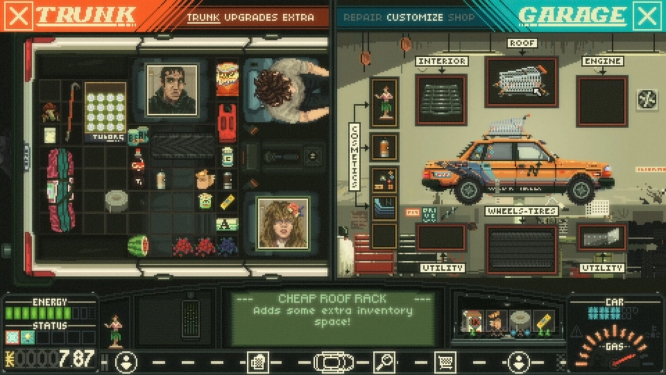
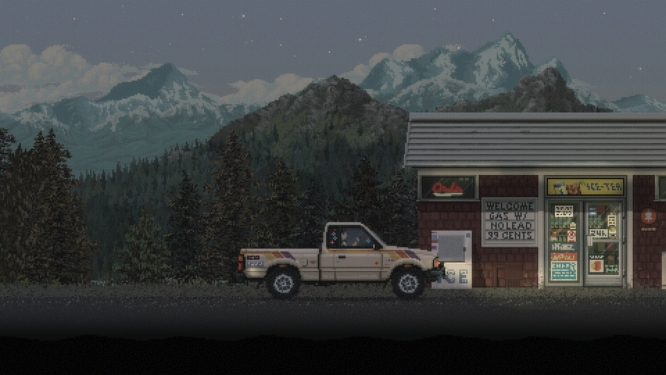
There are three vehicles to choose from, although only one is available at the beginning. The sedan is your starting option and the all-rounder: four seats, an average-sized boot and average engine. The truck sacrifices passenger space, offering just two seats, but provides considerably more storage. Finally, the muscle car also only has two seats and a small boot, but compensates with a much better engine. Because those differences influence both who and what you’re able to carry, choosing a vehicle isn’t simply cosmetic. It can alter the way a run develops.
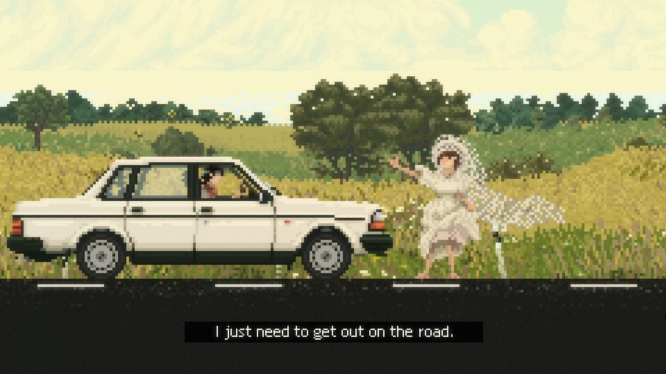
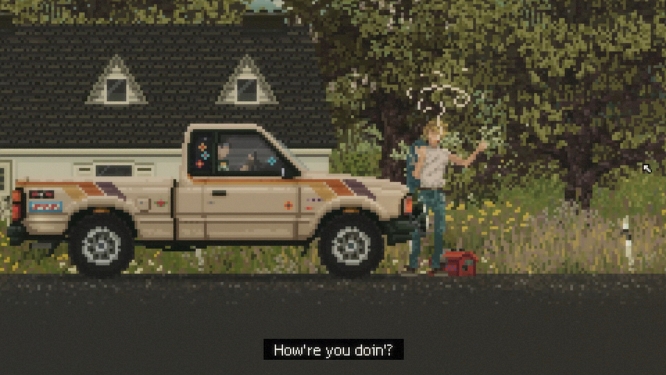
When on your travels, you’ll meet hitchhikers. Hitchhikers effectively become your RPG party members. They have their own abilities, can be levelled up and bring personal stories, conversations, quirks and side quests along for the ride. I met a mechanic who wanted me to upgrade my car. A stoner who wanted weed and for me to drive drunk. A lost little girl trying to find her parents. And because the people and events you encounter are randomised, individual runs can develop their own personality. Some journeys become relatively wholesome road trips. Others… well, there’s potentially some illegal activity going on. Let’s just say getting pulled over by the police becomes considerably more concerning when there’s some coke in your car… and I don’t mean the fizzy beverage.
It’s these unpredictable encounters that stop Keep Driving from becoming nothing more than a collection of resource bars. You’re managing numbers, certainly, but those numbers become attached to little stories. A bad decision in one town can create a problem several stops later. A hitchhiker you hadn’t planned on collecting can change your priorities. An apparently worthwhile detour can leave you stranded. After a while, you stop thinking of a run purely in terms of winning or losing and start remembering the journey itself.
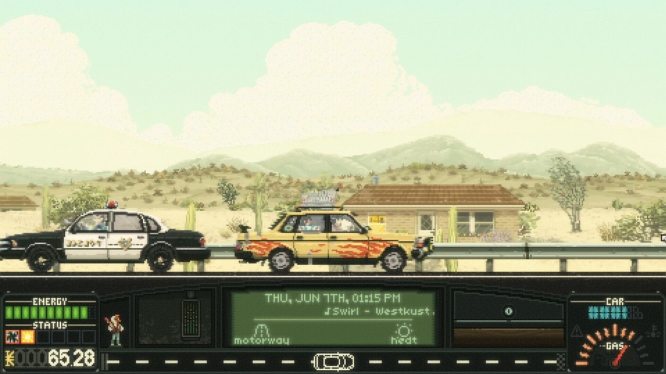
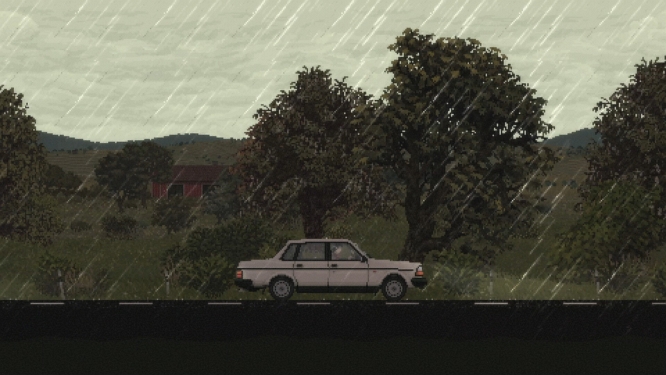
Then there are the visuals. Keep Driving’s pixel art is wonderfully detailed, and despite spending so much time staring at the road from essentially the same perspective, there’s nearly always something worth looking at. The scenery changes depending on where you’re travelling, shifting through countryside, cities, dirt roads and motorways. Rain and fog aren’t merely visual flourishes either, as weather can affect both your character and the road events you encounter. Your car gradually tells a story of its own. Mud builds up. Damage becomes visible. The vehicle you started the trip with can begin looking every bit as battered and exhausted as you feel That visual wear and tear suits the game beautifully. This isn’t a road trip presented as a collection of pristine postcards. It’s messy.
The soundtrack is just as important to the atmosphere. Keep Driving is packed with indie bands and songs, all channelled through the CD player in your car. You begin with a selection of music but can discover and unlock more as you travel. Stick the player on shuffle, forget about it and sooner or later you’ll find yourself humming one of those indie tracks long after you’ve reached your destination. It all reinforces that early-2000s setting. The car, the CDs, the strangers, the roads. There’s something wonderfully nostalgic about it.
And about that music festival. Reaching it is only one of several possible endings So far, I’ve found four, and I know there are others still waiting to be discovered. Some are optimistic, some considerably more sombre, while others are simply funny. That variety makes replaying Keep Driving feel less like restarting the same campaign and more like setting off on another road trip to see what happens this time. And that brings me to something important. I didn’t particularly enjoy Keep Driving during my first run. For whatever reason, it simply didn’t click. The systems felt a little strange and I wasn’t entirely convinced there was enough here to keep me playing. But I stuck with it. Then something happened. It did click. Now I can’t stop playing.
The road events are simple enough to understand immediately, yet the turn-based battles contain enough depth to make resource management matter. The map offers enough freedom that a different route can completely alter a run. Different cars encourage different approaches. Hitchhikers create different opportunities and problems. Random events send carefully made plans straight out of the window. Individually, these systems are relatively straightforward. Together, they create unique stories. And that’s ultimately why Keep Driving works for me.
Released last year for PC, but now available on PlayStation, Xbox, and Switch. For a game supposedly about driving, the actual act of driving isn’t involved. This is about having just enough petrol to reach the next town. It’s about wondering whether you’ve got room in the boot for one more useful item. It’s picking up a stranger because they seem interesting. Taking a completely unnecessary detour. Getting yourself into trouble. Digging yourself back out again. It’s about sticking another CD into the player and seeing what’s further down the road.
Keep Driving is one of the most refreshing indie games I’ve played recently. If you’ve got fond memories of The Oregon Trail, or simply enjoy games where management systems, random events and player decisions combine to tell stories, then this is one road trip that’s absolutely worth taking. Just try not to ring your parents too often.


Please leave a reply/comment.